
Triskelion – Millennia Old Traditional Symbol Used In Many Cultures Around The World
A. Sutherland - AncientPages.com - Triskelion is a mysterious ancient symbol that has never been explained.
It has been found in Christian, Buddhist, Islamic, and Jewish contexts.
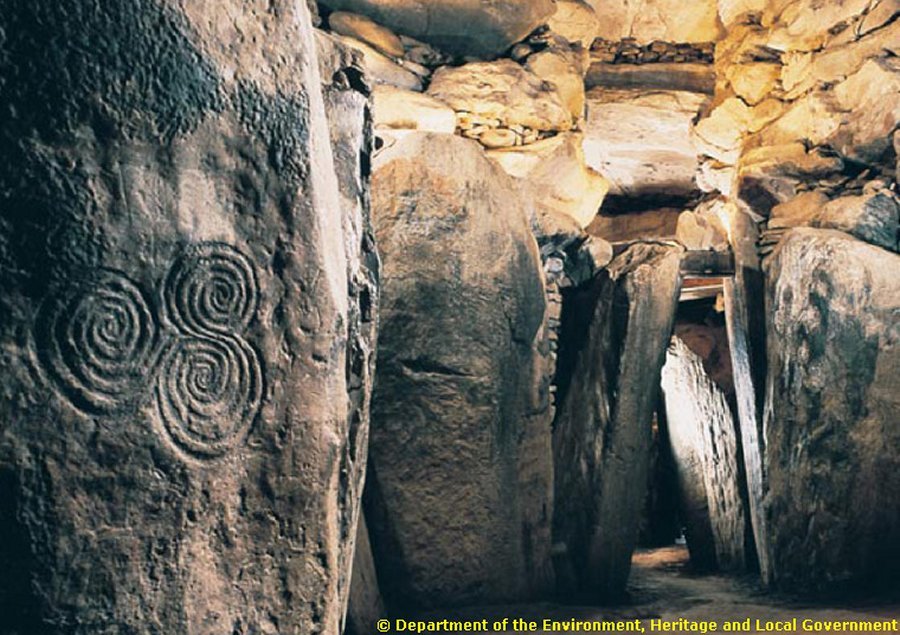
Tri-Spiral engraving – Newgrange Chamber. Image via newgrange.com
Triskelion (or triskele), in Greek: "tripod," "three-legged") is an ancient sign composed of three identical elements forming a triple spiral displaying rotational symmetry.
In Homer's "Illiad Book XVIII, we read:
"At the moment, Hephaestus was busily
Turning from bellows to bellows, sweating with toil
As he labored to finish a score of three-legged tables
To stand around the sides of his firm-founded hall…"
Triskelion displays only one shape repeated three times to form a wheel-like pattern. Traditionally, the sign represents three bent human legs (in Greek, it means tripod), but it does not necessarily have to be formed that way.
For example, it can be formed of three fishes, three intertwining spirals, or three teardrops.
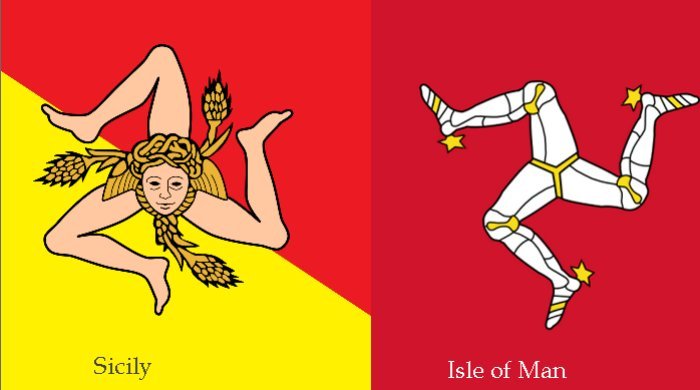
Left: The flag of Sicily contains the triskelion in the middle and the winged head of Medusa with three wheat ears which symbolizes the fertile land. (Adopted in 1282, after the successful Sicilian Vespers revolt against King Charles I of Sicily.) The present design of the flag was officially approved in January 2000. Image credit: Angelo Romano/Wikipedia; Right: Flag of the Isle of Mann, adopted in 1932, has the triskelion centered as a whole rather than based upon the imaginary circle created by the prongs of each leg. Image credit: Fry1989/Wikipedia
Old Symbol That Survived Millennia
Triskelions appeared in Neolithic art. The oldest preserved find of this traditional symbol, which was discovered in Malta, dates from 4400-3600 BC.
It is said that the triskelion is an ancient symbol used by the Mycenaeans and the Lycians.
Triskelion Found All Over Europe
Depictions of triskelion have been discovered across the European continent, in Ireland, Greece, Brittany, Lithuania, and other places. In Sicily and the Isle of Man, triskelion is depicted as three legs.
People left the sign of triskelion in the astronomical calendar at the megalithic tomb of Newgrange, Ireland, dated back to 3200 BC, as well as on Mycenaean vessels, on coinage in Lycia, and Greek pottery depicting warriors.
In Ireland's Celtic tradition, the three-element vortex is derived from Old-Celtic inscriptions. It can be found on ancient stones and other objects across the country.
When Christianity appeared in Ireland, this symbol became a graphic sign of the Holy Trinity (Father, Son, and Holy Spirit).
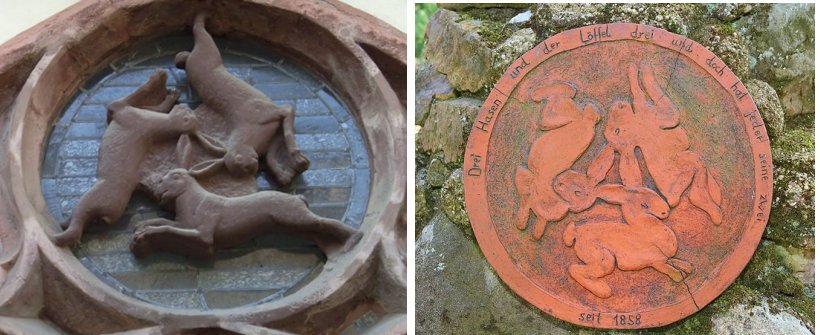
Left: Window of Three Hares, Paderborn, Germany. Image credit: Zephram/Wikipedia; Right: Three Hares Stone, Teutoburg Forest, North Rhine-Westphalia, Germany. Image credit: J.-H. Janßen/Wikipedia
The symbol is also included in the coat of arms of the Bavarian town of Füssen, Germany.
Triskelion Symbol As Three Hares (Or Three Rabbits)
These two ancient traditions have used the symbol in many different forms in carvings and art for a long time.
It comprises one shape repeated three times to produce a wheel-like pattern.
The three hares (or three rabbits) chasing each other in a circle is a circular motif based on threefold rotational symmetry.
This fascinating version of triskelion is seen in historical synagogues in Europe and sacred sites in the Middle and the Far East.
The hare triskelion, in particular, is still the source of many guesses. T
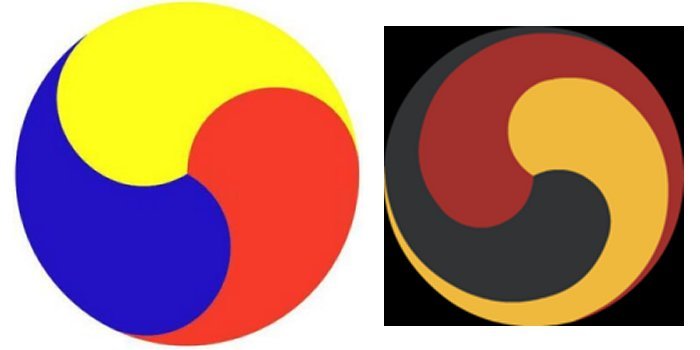
Three-part symbol Sam-Taegeuk (Korea). Blue = Heaven Red = Earth Yellow = Humanity. Heaven influences Earth, which influences Humanity, which influences Heaven. It is used in Korean Shamanism, Neo-Confucianism, Daoism, and Buddhism. Image credit: san-shin.org; Right: Tibetan Dharmacakra - a symbol in Tibetan Buddhism, the Wheel of Dharma, also called Gankyil. Image credit: Kava09 /Wikipedia
he earliest known examples of this design were discovered in Buddhist cave temples of China between 581 and 618 AD. Later, the design spread along the crowded and famous Silk Road and finally reached the Middle East and several European countries.
Triskelion In Ancient Tradition Of Asia
The symbol was found in ornate metallic carvings, ceramics, glass objects, and even textiles.
Traditional Asian versions of the triskelion include the Japanese Mitsudomoe, the Tibetan Buddhist Gankyil, and the Korean Sam Taegeuk.
The tomoe - emblem history in Japan - was also found among the Ainu people, and it is similar to the western Asian figure of the triskelion.
Modern Depictions Of Triskelion
The United States Department of Transportation seal, adopted on February 1, 1967, depicts a triskelion pattern. The three comma shapes represent air, land, and sea transportation.
In a British fantasy-adventure drama television program, Merlin (2008), the symbol was used as a symbol of druids.
Written by – A. Sutherland - AncientPages.com Senior Staff Writer
Updated on March 16, 2024
Copyright © AncientPages.com All rights reserved. This material may not be published, broadcast, rewritten or redistributed in whole or part without the express written permission of AncientPages.com
Expand for references
More From Ancient Pages
-
 1,600-Year-Old Pendants Depicting Humans And Animals Excavated In Ancient Port-City Of Assos
-
 Reports Of Mysterious Whistling Giants Roaming The Cascade Mountains – Ancient And Modern Accounts
-
 Mystery Of Zendan-e Eskandar – Alexander The Great’s Prison
-
 Prophetic Dream Revealed Priceless Ancient Treasure That Was Later Stolen Or Destroyed – Was The Discovery Too Dangerous?
-
 Parthian Jar Burial Dated To 247 BC – 224 CE Unearthed In Iran’s Kurdistan Province
-
 Adorable Village Of The Little People In Connecticut
-
 Hundreds Of Bronze And Iron Age Artifacts Discovered On Hungary’s Volcanic Somló Hill
-
 Biblical City Of Tarsus: Excavations Reveal Its Secrets From Paul the Apostle’s Times
-
 ‘Collata Quipu’ May Explain Messages Hidden In Mysterious Writing Of Inca
-
 Enigma Of Ancient Upside Down Stairs At Sacsayhuamán
-
 Ancient Inventions Of Firefighting Vehicles
-
 Human Migration Out Of Africa To Middle East Through Corridors Provided By Monsoons
-
 Impressive Kaymakli Underground City – An Ancient Hiding Place
-
 Sparta And Legendary King Leonidas: The Heroes Of Thermopylae
-
 Spectacular Ancient Underground ‘Stonehenge’ Dolmen De Soto Reveals Its Secrets
-
 World’s Oldest And Largest Maya Structure Revealed By LIDAR
-
 Stone Homes Of Europe’s First Megalithic Builders Discovered
-
 The Strange Story Of The Grave Of Copernicus
-
 Circular Stepped Pyramids Of Guachimontones And Teuchitlan Tradition – A Lost Ancient World In Mexico
-
 On This Day In History: Fatal Fire Broke Out In Tre Kronor “Three Crowns” Castle, Stockholm, Sweden – On May 7, 1697

