
London’s Underground Rivers Were Deliberately Hidden
Ellen Lloyd - AncientPages.com - When you think of London, many things come to mind, but not the fact that many hidden underground rivers flow beneath the significant capital of the UK.

Traces of London's lost rivers are visible throughout the city, if you know what to look for Photo: SF Said
Below the ground is a vast network of tunnels and chambers, put in place by Victorian engineers, the final step in a process which took centuries.
London once needed all the rivers it could get: for drinking water, for harbors and wharves, for mills, for tanneries, and for sluicing away waste. The rivers were London's sewage system long before any system was built. Still, even tiny medieval London was too much for any stream to cope with, and many inner London waterways remained deliberately hidden.
The Fleet is probably one of the better-known rivers located beneath Londoners' feet.
Vestiges of it can be traced above ground by following a modest stream that flows from Hampstead and Highgate Ponds in north London.
 The Victorian brickwork from Joseph Bazalgette's sewer system remains in a preserved state. Image credit: Emma Lynch BBC
Today it is swiftly submerged, becoming a sewer that flows to Blackfriars Bridge on the River Thames.
During Medieval times the waters of the Fleet were renowned for being clean.
As London city grew, mills, tanneries, and meat markets appeared along its banks. Water was vital to keep these industries functioning and growing.
Gradually, however, the river was polluted with blood, sewage, and other waste, so it became a waste tip, an easily accessible repository to discard anything unwanted, including the carcasses of dead livestock.
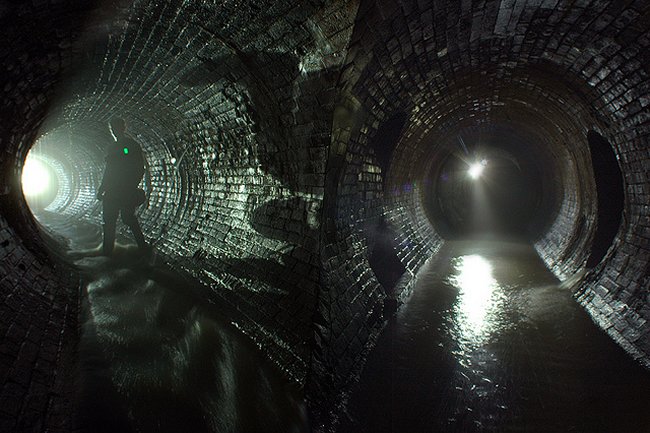
Image Credit Flickr User sub-urban.com
London's origins are deep in the Walbrook, the river around which the Romans founded the city. The debris dug from the river – hoes and plow shares, chisels and saws, scalpels and spatulas, the heads of forgotten gods, and a collection of 48 human skulls tell the earliest London tales.
As a result, over the years, the river became shallower and the water much slower than in previous generations, only exacerbating the burgeoning problem of the health hazard it now presented. It would silt up in the summer, and although the spas and wells upstream remained open and functioning, the Fleet in London became an open sewer with a mix of slums and prisons on its banks. Something had to be done.
 The Walbrook's name derives from the fact the brook passed by the Roman city's wall. Image credit: Alan Sorrell/Museum of London
A solution was urgently needed. The architect Sir Christopher Wren was afforded the chance of transforming the lower Fleet. The Great Fire of London in 1666 provided that opportunity.
The river was channeled underground in the 1730s from Holborn to Fleet Street, which still bears its name. Decades later, it was filled in and arched over from Fleet Street down to the river Thames and is covered by what is now New Bridge Street.
Perhaps, the rivers are hidden, but they are far from gone. It is tough to stop a river from flowing, so they have merely been diverted into the sewer system.
Written by - Ellen Lloyd – AncientPages.com
Copyright © AncientPages.com All rights reserved. This material may not be published, broadcast, rewritten or redistributed in whole or part without the express written permission of AncientPages.com
Expand for referencesMore From Ancient Pages
-
 Shangshan Culture Drank Ancient Rice Beer 10,000 Years Ago – Archaeological Evidence Found In China
-
 Ancient Atlantean Sculpture Discovered At The Mayan Chichen Itza Archaeological Site
-
 Giant Hrungnir Who Lost The Race And Engaged In A Deadly Duel With Mighty Thor In Norse Mythology
-
 Skeletal Remains Of A 1,500-Year-Old Byzantine Ascetic Monk, Chained In Iron Rings – Uncovered Near Jerusalem
-
 Unexpected discovery of hidden color in ancient mummy portraits
-
 Evolution Of Tree Roots Led To Ancient Mass Extinctions – Geologists Say
-
 Why Did People Start Eating Egyptian Mummies? The Weird And Wild Ways Mummy Fever Swept Through Europe
-
 Arian Tower: Pyramid-Shaped Mausoleum Of Nobleman Was Built On Top Of Medieval Hill Fort
-
 Golden Figurine From Yozgat Depicts Unknown Hittite God
-
 Rare Eleventh-Century Astrolabe Unearthed Recently Sheds Light On Islamic-Jewish Scientific Exchange
-
 Little Known History Of Amazon’s Ashaninka People Studied By Researchers
-
 Unsolved Prehistoric Enigma Of Sophisticated Spiro People And Their Mysterious Mounds
-
 Surya: Hindu Sun God Who Illuminates The World, Our Lives And Disperses Darkness, Destroys Diseases, And Enemies
-
 Young Girl Finds Rare Ancient Megalodon Shark Tooth On Maryland Beach
-
 The Phrase Hip Hip Hooray Has Ancient Roots
-
 Future Of Thornborough Henges Secured – Stonehenge Of The North Preserved For The Nation
-
 Apedemak: Did The Three-Headed Lion War God Of Kush Originate From Ancient India?
-
 Tower Of The Winds And Daydreaming Of Andronicus Of Cyrrhus
-
 Is This The Face of Queen Elizabeth I?
-
 Caribbean Cannibalism Theory – Debunked By Researchers

