
Pergamon – One Of ‘Seven Churches Of Asia’ With Great Library And Sophisticated Water Supply System
Angela Sutherland - AncientPages.com - Pergamon is mentioned in several sources from about 400 BC. German archaeologists investigated the city of Pergamon for more than a century.
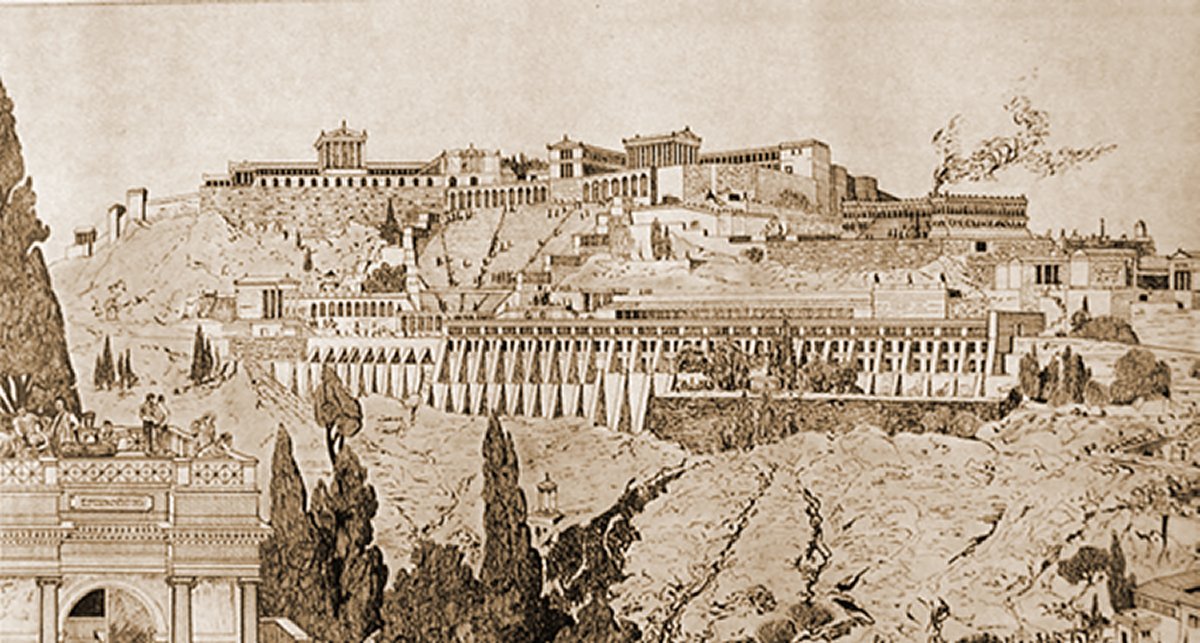
Reconstruction of Pergamon - 19th Century Germany Drawing
Pergamon (Pergamum) was an ancient city of Mysia located in West Anatolia about 100 km north of Izmir, Turkey. Today, the town of Bergama is located on Pergamon's ruins, but the excavations have revealed several spectacular ruins that shed light on ancient Pergamon's history.
It was an ancient Greek city and became the capital of the Kingdom of Pergamon during the Hellenistic period, under the Attalid Dynasty (282 BC-133 BC). It was also the capital of the Roman province of Asia for a short time - before the capital was moved to Ephesus.
Among the ruins is the Acropolis reserved for official buildings, the Altar of Zeus, and the temples of Athena, Dionysus, and Trajan. In the Heroon shrine, the kings of Pergamon were worshipped. The famous Pergamon library, gymnasiums, Trajaneum theater, an amphitheater, and a huge forum were among cultural objects.
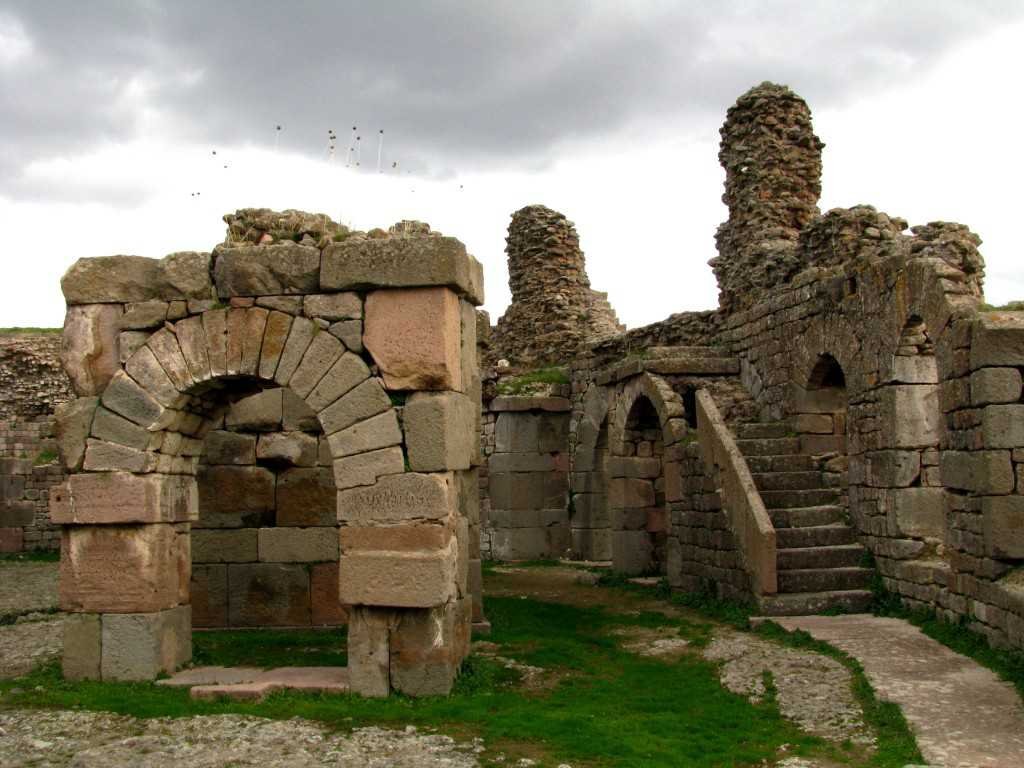
Sanctuary of Asclepion has a big galleried courtyard Image Credit: GNM - MATAHARI Travel Services Turkey
Pergamon - one of the Seven Churches of Asia, mentioned in the 'Book of Revelation' - was home to about 200,000 inhabitants and played an essential role in the early history of Christianity.
Approximately forty aqueducts and 240,000 clay pipes provided the city with water taken from 30 miles away; water even reached the Acropolis, situated over 300 m above sea level, at the top of an isolated hill.
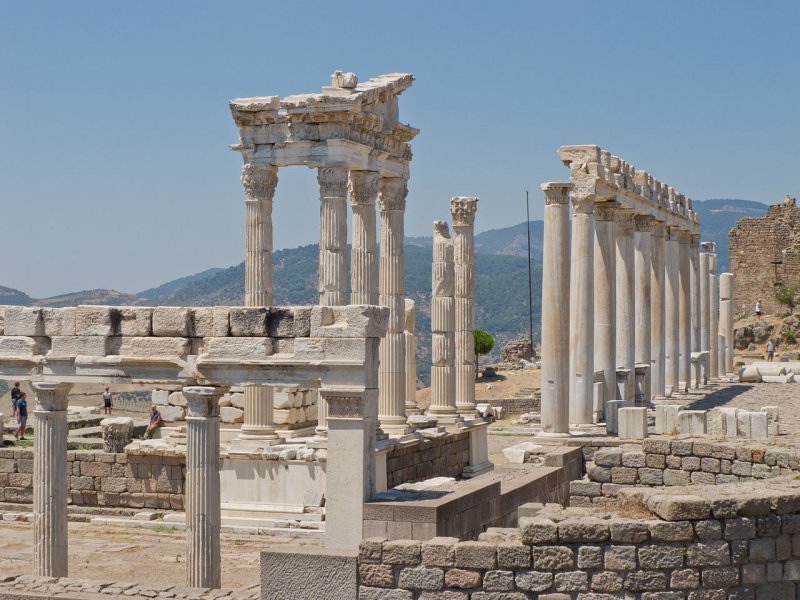
Temple of Trajan at Pergamon, in modern-day Turkey. Image credit: Carlos Delgado - CC BY-SA 3.0
Roman engineers managed to create such pressure conditions that the water reached a cistern located on the highest point of the Acropolis. They built a water supply system consisting of pipes and water towers.
The cisterns of the Acropolis have been surveyed and analyzed thoroughly by German researchers working at Pergamon. These structures were crucial parts of the municipal water supply; it has been calculated that about 20.000 city's inhabitants could have survived the year-long siege with their help.
However, it was not the only way of supplying the city with water. Pergamon also had Roman aqueducts, network waterworks, fountains, and wells.
Pergamon's therapeutic and healing center, the Sanctuary of Asclepius (the god of medicine and healing), was famous due to the presence of eminent Roman physician Galen (c. 129–200 AD), who was born in Pergamon. The medical center used alternative treatments to heal sick patients, with diagnoses often coming from dream analysis.
Treatments included; bathing in, or drinking water from sacred springs, massage, mud baths, and use of herbs and salves. Small clay or terracotta body parts found around the site could be gifts from healed customers of the center.

Red Basilica, one of the seven important churches in Early Christianity, was built on the temple of Serapis, Bergama. Image credit: - CC BY-SA 3.0
Among Pergamon's other notable structures was the Red Court (the 2nd century AD). It was later converted into 'Red Basilica' and dedicated to Egyptian gods and goddesses, especially Serapis (primarily a healer of the sick, a deity who was superior to fate and who retained from Osiris the character of a god of the underworld. The structure's forecourt is still supported by the 196 m (643 ft) wide Pergamon Bridge, a remarkable achievement of ancient engineers.
The Library of Pergamon - founded during the rule of king Eumenes II (197-159 BC) - was renowned. It is second only to the Library of Alexandria, although not approaching Alexandria in scholarship but rather in the number of volumes they possessed.
According to the writings of Plutarch (46-120 AD), the library was believed to contain 200,000 volumes. Mark Antony later gave these to Cleopatra as a wedding present, eventually being added to the collection of the library in Alexandria.
Written by – A. Sutherland AncientPages.com Staff Writer
Updated on July 13, 2022
Copyright © AncientPages.com All rights reserved. This material may not be published, broadcast, rewritten or redistributed in whole or part without the express written permission of AncientPages.com
Expand for referencesReferences:
Picón Carlos A. Pergamon and the Hellenistic Kingdoms of the Ancient World
More From Ancient Pages
-
 Celts: Facts And History About The Powerful And Intriguing People Of Central And Northern Europe
-
 Remains Of Ancient Predators Shed Light On How Humans Did Or Didn’t Find Food
-
 Chavín Phenomenon: Ancient Andean Society Used Hallucinogens To Reinforce Social Order And Leadership
-
 Well Of Urd (Urdarbrunn): Abode Of Fate Goddesses And Powerful Symbol In Norse Beliefs
-
 Little People: Ancient Race That Pre-Dates Native Americans, Celts, And Other Settlers Worldwide
-
 Evidence Reveals Ancient Saudi Arabia Had A Complex, Thriving Society, Contradicting Notions Of A Struggling Population In Barren Lands
-
 Ancient Mystery Of The Tomb Of Tiryns – Burial Place For An Unknown Mycenaean Hero?
-
 Massive Head Of Hercules Pulled From The Antikythera Shipwreck
-
 Tiglath Pileser III: Neo-Assyria’s Strong King Who Built A Mighty Empire
-
 Two-Story Houses With Balconies Unearthed In Ancient City Of Pompeii, Italy
-
 Skull Reveals Little Foot Was Capable Of Different Head Movements Than Modern Humans
-
 Delatores – Who Were The Professional Gossip Collectors In Ancient Rome?
-
 World’s Oldest Moon Map Carved Into Ireland’s 5,000 Year-Old Tomb At Knowth
-
 People Of Old Dongola Recycled And Dyed Clothes
-
 A 500-Year-Old Stolen Copy Of da Vinci’s “Salvator Mundi” Painting – Found By Italian Police
-
 Code Of Chivalry: ‘Knightly’ Behavior, Courageous Medieval Knights, Warriors And Superior Men
-
 Old Kingdom Of Alashiya And City Of Enkomi With Roots On The Island Of Cyprus
-
 Mystery Of The First Dinosaurs Deepens – Is The Supercontinent Gondwana The Answer?
-
 Antediluvian Discoveries In Britain, Germany And France That Could Re-Write History
-
 Diver Says He Found Mysterious Underwater Ancient Tomb, Ruins And Artifacts Of An Unknown Advanced Civilization

