
Chocolate Was A ‘Hot Property’ In 17th Century England And There Were Rules For Safe Consumption
Ellen Lloyd - AncientPages.com - In 1675, King Charles II of England issued a proclamation to end the legality of coffeehouses. He banned coffeehouses and forbade people from selling coffee, chocolate, sherbet, and tea from any shop or house. The ban was later lifted, but the history of chocolate consumption in England has been interesting, to say the least.
Chocolate was 'hot property' in the 17th century - and subject to rules for safe consumption, according to Dr. Kate Loveman, a lecturer at the University of Leicester, who has uncovered the first - nearly 350 years old - English recipes for iced chocolate desserts.
In the 17th century, however, these chilly treats were believed to be as dangerous as they were delightful.

Chocolate House London. Credit: Public Domain
The Earl's own recipe reads: "Prepare the chocolatti [to make a drink]… and Then Putt the vessell that hath the Chocolatti in it, into a Jaraffa [i.e. a carafe] of snow stirred together with some salt, & shaike the snow together sometyme & it will putt the Chocolatti into tender Curdled Ice & soe eate it with spoons."
"It's not chocolate ice-cream, but more like a very solid and very dark version of the iced chocolate drinks you get in coffee shops today. Freezing food required cutting-edge technology in seventeenth-century England, so these ices were seen as great luxuries," Dr. Loveman said.
"Chocolate was first advertised in England around 1640 as an exotic drink made from cacao beans. In the 1660s, when the Earl of Sandwich collected his recipes, chocolate often came with advice about safe consumption."
"One physician cautioned that the ingredients in hot chocolate could cause insomnia, excess mucus, or haemorrhoids. People worried that iced chocolate in particular was 'unwholesome' and could damage the stomach, heart, and lungs."
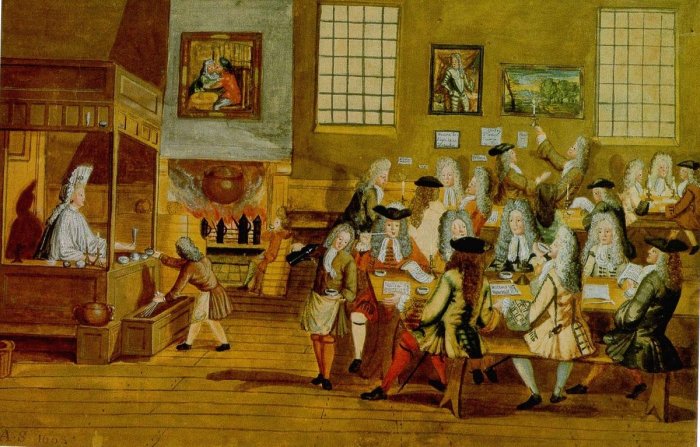
Interior of a London Coffee-house, 17th century. Credit: Public Domain
"There were ways round this, however. Sandwich thought the best way to ward off the dangers of eating frozen chocolate was to 'Drinke Hott chocolatti ¼ of an houre after' it. In other words, chocoholics are not new.
"I tried out the freezing method using snow - and lived to tell the tale, despite not following Sandwich's advice."
Dr. Loveman found a range of chocolate recipes in the Earl of Sandwich's journal, written after he became enamored of the drink while ambassador extraordinary to Spain in the 1660s.
The manuscript includes King Charles II's prized recipe for spiced and perfumed chocolate - which Sandwich reported cost the King £200.
From the 1640s, chocolate was sold as an exotic drink that could cure illnesses and act as an aphrodisiac.
The truth often played second fiddle to promotion: one purveyor, Captain James Wadsworth, claimed as early as 1652 that chocolate was "thirsted after by people of all Degrees (especially those of the Female sex) either for the Pleasure therein Naturally Residing, to Cure, and divert Diseases; Or else to supply some Defects of Nature".
As chocolate sellers sprung up across London in the 1650s, a milky version of the drink began to be sold in coffee houses.

Credit: Adobe Stock - Nitr
"The novice chocolate drinker of the 1650s and 1660s ran greater risks than money ill spent: he had to bear in mind that the new product might damage his health and there was the real possibility of loss of face through having his inexperience exposed," Dr. Loveman said.
By the 1690s elite 'chocolate houses' were selling the drink to an aristocratic and leisured clientele. Chocolate was widely mentioned in the literature and had already acquired some of the associations with indulgence and pleasure it has today.
"Today's chocolate promoters, like some in the seventeenth century, often find cause to highlight women, pleasure, and sexuality.
"In the seventeenth century, however, the fact that frequent chocolate consumption might make you 'Fat and Corpulent' was an attraction, something advertisers now prefer to keep quiet about."
Written by - Ellen Lloyd – AncientPages.com
Updated on October 11, 2023
Copyright © AncientPages.com All rights reserved. This material may not be published, broadcast, rewritten or redistributed in whole or part without the express written permission of AncientPages.com
More From Ancient Pages
-
 Jigai – Suicide Ritual For Wives Of Samurai – Feminine Counterpart Of Seppuku
-
 Fossil Bones From The Largest Penguin That Ever Lived Unearthed In New Zealand
-
 Cappadocia And Huge Unique Selime Cathedral
-
 1,900-year-old ‘water law’ unearthed in Laodicea
-
 Ancient Mystery Of Giant Mounds Of Jerusalem Built For Unknown Reasons – Archaeologists Are Still Baffled
-
 Philippine Ayta People Have The Highest Level Of Denisovan DNA – New Study
-
 Did Ancient Oshoro Stone Circle Serve As A Portal To The Spirit World?
-
 New Clues About The Kensington Runestone Rewrite Ancient History But One Mystery Remains
-
 Enigma Of Giant Statue Of Kouros Of Apollonas
-
 Mystery Of Panxian Cave: How Could Gigantic Animals Reach A Mountain Cave Located Over 1600m Above Sea Level?
-
 Pasargadae: Capital Of Achaemenid Empire Destroyed By Alexander The Great
-
 Knowledge Of Secret Ancient Underground Civilization Revealed By Maya Priests
-
 Thousand-Year-Old Farming Techniques And Irrigation Systems Can Be Used To Mitigate Climate Change
-
 Magnificent Alsengem Among 30,000 Archaeological Objects Discovered In Kalmar, Sweden
-
 Neanderthals In Swabian Jura Used Complex Tool-Making Techniques 45,000 Years Ago
-
 CT Scanning And 3D-Modelling Used To ‘Unfold’ Ancient Silver Plate Found In Jerash
-
 Why Did God Zeus Give King Sisyphus An Eternal Punishment?
-
 Hagar Qim: “Standing/Worshipping Stones” – Megalithic Complex In Malta Dated To 3600 – 3200 BC
-
 Archaeological Finds Shed New Light On The Paleo Diet Habits Of Ancient Hunter-Gatherers
-
 Babylon Excavation Uncovers 478 Artifacts, Including Cuneiform Tablets and Seals

