
Antisthenes And Diogenes – Founders Of Cynicism Were Ancient Greek Philosophers
Ellen Lloyd - AncientPages.com - The concept of cynicism comes from the Greek word for dog ( kynos), but originated in a philosophical school established in ancient Greece.
Denoting their denial of luxuries, wealth, and social status, cynics believe the purpose of life is to live in virtue, in agreement with nature.
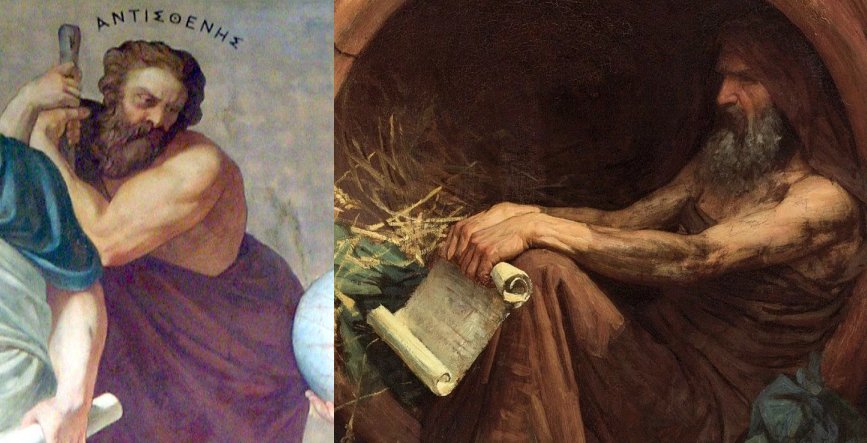
Left: Antisthenes, part of a fresco in the National University of Athens. Right: Diogenes of Sinope lived in a barrel in downtown Athens, (by Waterhouse)
This meant satisfying only the most basic requirements of the body by the simplest means possible.
The Cynic School, founded in Athens about 400 B.C., continued in existence until about 200 B.C. The founder of the school was Antisthenes, (c. 445–365 B.C.) a Greek philosopher who was a pupil of Socrates. The best known among his followers is Diogenes of Sinope (c. 412–323 B.C.)
Antisthenes said that desire leads to pleasure and pleasure to the misery of insufficient and temporal happiness. Antisthenes valued virtue more than anything. In his opinion, virtue is the only good, and pleasure is always evil. Self-control is the essence of virtue.
According to his philosophy, wise people learn to above all things to despise material needs and the artificial comforts in which worldly men find happiness.
Self-control, he said, is the essence of virtue, and a wise man will learn above all things to despise material needs and the artificial comforts in which worldly men find happiness. Virtue was according
Nicknamed ‘the dog’ for his vagrant lifestyle, Diogenes was described as ‘a Socrates gone mad’.

Alexander the Great's meeting with Diogenes.
Diogenes took the concept of cynicism to its highest level. Legends tell Diogenes lived in a barrel (actually a kind of storage jar) on the outskirts of the marketplace. He made his living by begging, refusing to wear anything but the simplest of cloth.
Diogenes was sometimes referred to as “Diogenes the dog”, but he was by no means offended by this. To him, it was almost like a compliment because he believed dogs were more in touch with nature. Dogs do not care for social status or material possessions.
The happiest person, who in Diogenes’ phrase “has the most”, is, therefore, someone who lives in accordance with the rhythms of the natural world, free from the conventions and values of civilized society, and is “content with the least”.
Alexander the Great who was his great admirer met the Greek philosopher in Corinth while he was bathing in the morning sunlight. The King of Macedonia asked Diogenes if there was anything he (a man who seemingly had everything) could do for him.
The philosopher responded, “Yes, stand out of my light”. Alexander the Great was said to have been so impressed with the remark that he then stated “If I were not Alexander, I would wish to be Diogenes”.
As a general philosophic principle, cynicism was highly influential upon the later Stoic philosophers.
Written by Ellen Lloyd – AncientPages.com
Copyright © AncientPages.com & Ellen Lloyd All rights reserved. This material may not be published, broadcast, rewritten or redistributed in whole or part without the express written permission of AncientPages.com and Ellen Lloyd
Expand for referencesMore From Ancient Pages
-
 Symbol of Immortality: Honey Offering In A 2,500-Year-Old Shrine – Identified
-
 1,300-Year-Old Avar Warrior Tomb With Rare Well-Preserved Treasures Discovered In Hungary
-
 Mysterious Mummified Woman With A Christian Cross On Her Chest Dashes Hopes Of Finding First Russian Fortress In Yakutia
-
 Chocolate Was A ‘Hot Property’ In 17th Century England And There Were Rules For Safe Consumption
-
 On This Day In History: Canute Lavard Was Murdered By His Cousin, Magnus I Of Sweden – On Jan 7, 1131
-
 Humans Used Northern Migration Routes To Reach Eastern Asia
-
 Major Breakthtrough – Ancient Herculaneum Scroll Deciphered For The First Time
-
 Oldest Human Made Architectural Plans Detail Mysterious Desert Megastructures
-
 New Clues To Minoan Writing System
-
 The Cyclades And Their Advanced And Mysterious Society Lost In Time
-
 Resourceful Pre-Hispanic Society In Bolivia Had Flourishing Agriculture Despite Harsh Environment Of The Andes
-
 Baffling Copper Scroll – A Treasure Map Leading To A Secret Lost Temple?
-
 Puzzling Connection Between Native Americans And Lost Northern European Race Could Re-Write History
-
 Who Were The Satraps Of The Achaemenid Empire?
-
 Are Bones Of Apostle Peter Hidden Inside A 1000-Year-Old Roman Church?
-
 Mass Production Of Stone Bladelets Led To A Cultural Shift In Paleolithic Levant
-
 Ancient Nandivardhan Was The City Of Vakataka Rulers Who Built Ajanta Caves
-
 Ancient Greeks Regret Inventing The Theater – But Why?
-
 4 Things Ancient Greeks And Romans Got Right About Mental Health
-
 Roman Roads Laid The Foundation For Modern-Day Prosperity – New Study Claims

