
Pants And Boots Were Forbidden In Ancient Rome – Trousers Were A Symbol Of Barbarism To Ancient Romans
Conny Waters - AncientPages.com - If you lived in ancient Rome, you would think twice before putting on your pants.
To ancient Romans, trousers were the ultimate symbol of barbarism, and no honorable man wanted to be considered the garb of a savage barbarian.
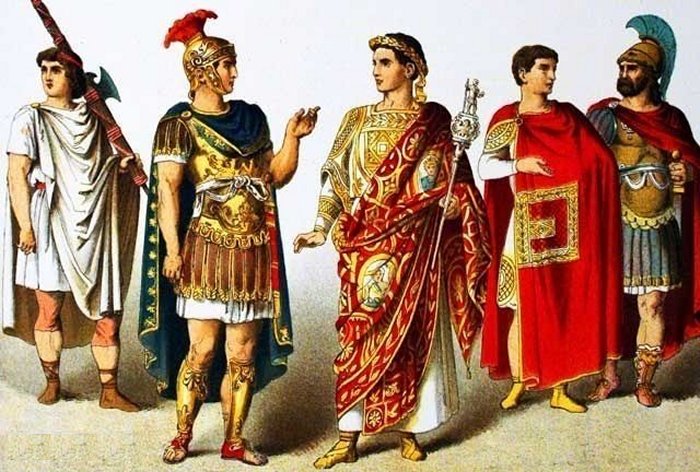
Credit: Costumes of All Nations (1882) by Albert Kretschmer - Public Domain
There was even a law that strictly prohibited wearing pants and boots in ancient Rome.
Pants and boots (called in Latin 'bracae') were associated with horse-riding barbarians, including many Germanic groups such as Goths, Huns, Vikings, and others.
The term "Barbarians" is today significantly misused. The original meaning of the word "barbarian" did not refer to acts of evil but rather to those who were not Greek or did not speak Greek. In modern times we often say Barbarians are uncivilized people or evil people.
When Ovid, a Roman poet who lived during Augustus's reign, encountered barbarians in today's Tomis, Romania, he wrote:
"The people, even when they were not dangerous, were odious, clothed in skins and trousers with only their faces visible."
One law from 397 and another dated to 399 CE strictly regulated wearing pants and boots in Rome.
Within the city of Rome, no one shall wear pants or boots. But if any man after the issuance of this regulation of Our Clemency should obstinately persist in such contumacy, he shall be punished accordingly as his legal status permits and expelled from our sacred city (Codex Theodosianus, 14.10.3 (June 6, 399 CE)

Gaulish chief Vercingetorix, wearing trousers, surrenders to Julius Caesar after the battle of Alesia in 52 B.C. Painting by Lionel Royer (1852–1926) - Credit: Public Domain
According to Susanne Elm, a historian from the University of California, Berkeley, who studies Rome's relationship with the tribes to the north, "barbarian influence on fashion was something that emperors wanted to control, but then their bodyguards, which presumably they trusted, were barbarians."
The ban on trousers and boots was a desperate attempt to keep the Roman identity alive. During this period, the Empire had become a melting pot of traditions after hundreds of years of expansion and cultural appropriation. Long hair and flashy jewels soon joined boots and pants as forbidden fashion.
"By the fifth and sixth centuries, suddenly the so-called barbarian custom, sleeved top, and trousers had become the official uniform of the Roman court. If you were close to the emperor, that's what you would wear." Professor Kelly Olson, the author of "Masculinity and Dress in Roman Antiquity," said. "Scholars have not yet been able to explain how that happened, trousers going from being banned from being legally required clothes for the Roman court."
It could be explained by the fact that ancient Romans, who were totally against trousers and boots, changed their attitude when Roman soldiers marched into cold Northern Europe and realized the benefits of wearing warm clothes and shoes.
Written by Conny Waters – AncientPages.com Staff Writer
Updated on October 29, 2022
Copyright © AncientPages.com All rights reserved. This material may not be published, broadcast, rewritten or redistributed in whole or part without the express written permission of AncientPages.com
Expand for references
More From Ancient Pages
-
 Magnificent Solar Alignment Phenomenon In Abu Simbel – The Sun Illuminates The Face Of Pharaoh Ramses II
-
 Huge Ancient Underground Stone Circle Discovered Inside Cornwall Neolithic Henge
-
 ‘Blue Highways’ Helped Middle Stone Age Humans Who Survived The Toba Supereruption 74,000 Years Ago
-
 Luna Settlement: First Multi-Year European Settlement Identified In Pensacola, Florida
-
 Mysterious Prehistoric Statues In Bada Valley, Indonesia Surrounded With Countless Legends
-
 Sacred Number Four – Perfect Number And Deep Meaning Behind It
-
 Mysterious Viking Gerdrup Grave – Burial Place Of Sorceress Katla And Her Son Odd Mentioned In The Eyrbyggja Saga?
-
 Ancient Mystery Of The Village Where All Residents Vanished Overnight
-
 Prehistoric Human Migration In Southeast Asia Driven By Sea-Level Rise – Study Reveals
-
 Rock Stars: How A Group Of Scientists In South Africa Rescued A Rare 500 Kg Chunk Of Human History
-
 Mysterious Valkyrie Eir Remains An Enigma In Norse Mythology
-
 Viking Cork Settlement Re-Writes Ancient History Of Ireland
-
 Susanoo-no-Mikoto – Shinto God Of The Sea And Storms Was Banished From Heaven
-
 Why Did King Solomon Hide Advanced Technology In A Secret Place? – The Great Deception – Part 2
-
 Fragment Of A 1,750-Year-Old New Testament Translation Discovered
-
 2,000-Year-Old Knife With Denmark’s Oldest Runes Found On Funen
-
 Evidence For A Divergence Between Eastern And Western Mediterranean Indo-European Languages Finally Provided By Ancient Genomics Study
-
 Why Was Pharaoh Hatshepsut’s Reign Virtually Erased From History?
-
 Lost Ancient Pyramid City As Big As Manhattan Discovered In Mexico
-
 Mystery Of Feodor Kuzmich – Did Tsar Alexander I Fake His Death?

