
Did Captain Robert Jenkins’ Ear Start A War That Lasted 9 Years?
Ellen Lloyd - AncientPages.com - There are many reasons why humans start a war. Most common conflicts involve disputes over territories, money, or revenge. Sometimes unusual events can also lead to the start of a war.
The so-called War of Jenkins' Ear lasted 9 years, but there is much more to this story than “just” the loss of an ear.

Did Captain Robert Jenkins' Ear Start A War That Lasted 9 Years? - Background image: HMS Centurion captures Nuestra Señora de Covadonga in the time of the famous War of Jenkin's Ear. credit: Public Domain
On April 9, in 1731, while returning home from a smuggling mission in the West Indies, Captain Robert Jenkins’s ship Rebecca was boarded by Spanish coast guards on suspicion of smuggling near Havanna, Cuba.
As punishment for raiding Spanish ships, Juan de León Fandiño, commander of the Spanish coast guard ship, cut off Captain Jenkin’s ear with a sword and warned that the English King would suffer the same fate if ever caught doing the same.
Why Did England And Spain Fight Over An Ear?
Captain Jenkins returned to England and complained to the English King, but the event aroused little interest at the time.
In those days, there were frequent clashes in the West Indies between ships of the European colonial powers, usually over issues of trade.
The Spanish attempted to maintain a monopoly on trade with their colonies, which the British and others consistently tried to break. Britain sought to expand its trade in the Americas, and its sailors carried out illicit trade in Spanish territories. Both Spanish and British crews frequently launched raids on the other’s ships, making trade in the Caribbean increasingly expensive and risky.
As tension between England and Spain escalated over trading issues, the situation changed and Jenkins’ ear was used as a motif to start a war. The ear became a symbol for the outrage the British public increasingly felt towards what it perceived as Spanish aggression on the high seas.
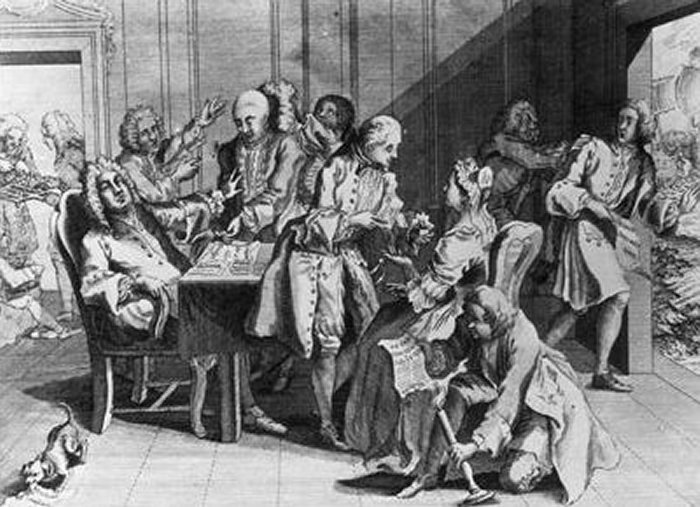 Captain Robert Jenkins shows his severed ear to Robert Walpole. Courtesy of British Museum, London
According to some sources, Captain Jenkins preserved his ear in a jar. Seven years later, he presented the ear to the Parliament, and the outraged English public demanded retribution. The ear simply added strength to existing demands for war.
Many historians say there is little evidence Captain Jenkins really told his story with dramatic details before a committee of the House of Commons, showing his severed ear pickled in a jar.
Instead, his plight was highly dramatized and contributed to the momentum of the political opposition campaign urging an immediate offensive against Spain.
What we do know, is that the British First Minister Sir Robert Walpole found himself increasingly under pressure from his opposition in Parliament and declared was in October 1739.
The conflict between England and Spain lasted from 1739 to 1748, but neither side was making significant gains.
The hysteria surrounding Jenkins’ Ear gave the war its name. However, in reality, the conflict was not about the loss of a body part but securing access to trade and resources.
Written by Ellen Lloyd – AncientPages.com
Copyright © AncientPages.com & Ellen Lloyd All rights reserved. This material may not be published, broadcast, rewritten or redistributed in whole or part without the express written permission of AncientPages.com and Ellen Lloyd
More From Ancient Pages
-
 Lao Tzu: Legendary Thinker And Founder Of Taoism Who Advocated Modesty, Self-Restraint And Balance
-
 Unusual Archaeological Object Reveals Traces Of Prehistoric Settlements Mikołajki
-
 Waru Waru – Ancient Andean Irrigation System Brought Back To Life
-
 On This Day In History: Henry VIII Ascended The Throne Of England – On Apr 22, 1509
-
 Wreckage of The French Steamship That Sank In Atlantic In 1856 Found Off The Coast Of Massachusetts
-
 On This Day In History: Johannes Kepler ‘Father Of Modern Astronomy’ Was Born – On Dec 27, 1571
-
 Norsuntepe – Little-Known Mysterious Prehistoric Site In Anatolia, Turkey: Why Was It Abandoned And Destroyed By Fire?
-
 Gigantic Bird Ziz Is One Of Participants At Messianic Banquet At The End Of Days In Jewish Folklore
-
 Surprising Discovery Of Unique 3,500- Year-Old Arrowheads Made Of Shells In The Jotunheimen Mountains
-
 Has A Herculaneum Scroll Solved The Mystery Of Plato’s Death?
-
 Discovery Of Chromosomes Offers Evidence Of Ancient Humans Living In South America Over 18,000 Years Ago
-
 Ancient DNA And Tombstones Lead Scientists To Black Death’s Source Strain
-
 On This Day In History: Heidelberg University Established – On Oct 19, 1386
-
 The Maasai Legend Of Hero Lakalanga And His Ancient Footprints
-
 Rare Ancient Precious Artifacts Found In Rusovce, Slovakia
-
 Rare, Unopened Ancient Egyptian Sarcophagus Whose Mystery Will Never Be Solved
-
 Golden And Silver Facial Ornaments, Wooden Figurines Among The Finds In Tomb Of Tibetan Plateau
-
 Longest European Burial Mound Pre-Dating The Egyptian Pyramids Discovered In Czechia
-
 3,000-Year-Old Wooden Structure Found In Hittite Tunnel Mentioned On Cuneiform Tablets
-
 On This Day In History: Malcolm III, King of Scots Died – On Nov 13, 1093

