
Mesopotamian City Jemdet Nasr Dated To 3100–2900 BC: Sophisticated Irrigation Techniques And Earliest Cylinder Seals
A. Sutherland - AncientPages.com - Jemdet Nasr - related to the Jemdet Nasr period (3100–2900 BC) - was a small but important prehistoric settlement in southern Mesopotamia, what is today, Babil located south of Baghdad, between the Euphrates and Tigris Rivers, Iraq.
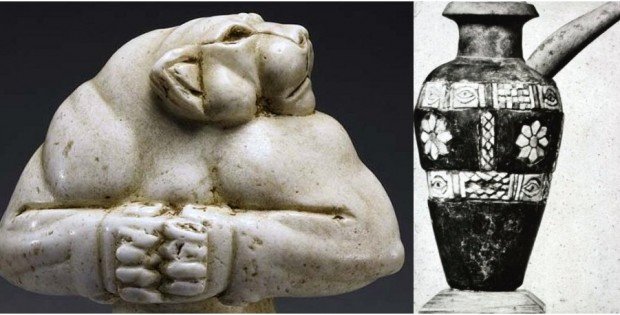
Left: Amazing Lioness-Woman Figurine dated stylistically to the Jemdet-Nasr period. (Sothebys New York; Right: Jemdet-Nasr pottery. Image:http://classics.unc.edu/
Excavations conducted in 1926 and 1928 revealed a large structure (92 × 48 m) constructed of both sun-dried and baked mud bricks, with clay roofing and ceramic gutters or drains. It had narrow rooms on three sides of a more open area, all resting on a brick platform. Additionally, more than two hundred inscribed clay tablets were found within the building.
The tablets and further excavations confirmed that ancient Jemdet Nasr was occupied during several periods, such as Ubaid (ca. 6500 to 3800 BC), Uruk (ca. 4000 to 3100 BC), and Early Dynastic (2900–2350 BC).
Jemdet Nasr ("Small mound of Nasr") experienced breakthroughs in the development of art, urban culture, writing, trade, and irrigation technology, which increased its importance. During this period numerous small Mesopotamian settlements developed into major cities, and the earliest cylinder seals came into use in southern Mesopotamia.
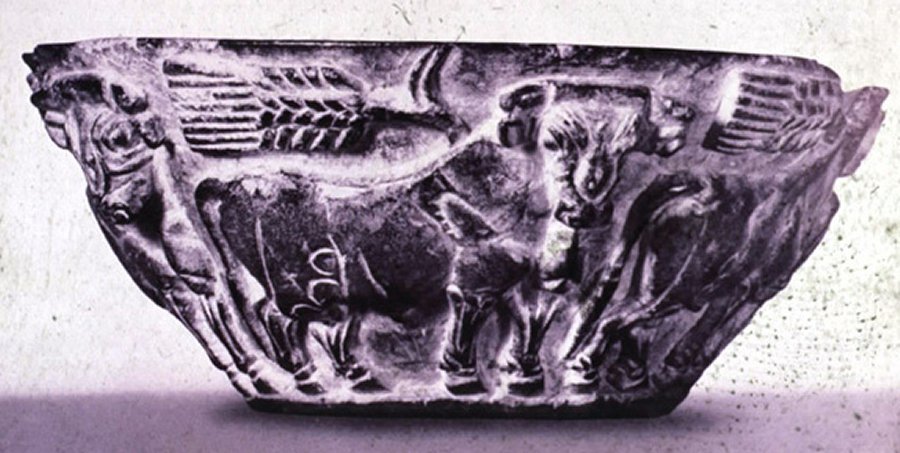
Steatite bowl with bulls in relief (5 cm. high). Found in a house of much later (Persian) times; dated stylistically to the Jemdet-Nasr period. Image credits: classics.unc.edu/
Pottery and cylinder seal impressions
The main features of the Jemdet Nasr are copper objects and pottery (large jars, bowls, spouted vessels, and cups), usually painted black and red geometric patterns. Other pottery forms found at the site include painted pots depicting both geometric motifs and depictions of animals, including birds, fish, goats, scorpions, snakes, and trees.
The pottery and cylinder seals clearly mark the difference between the Jemdet Nasr period (circa 3100-2900 BC) Jemdet Nasr and the proceeding Uruk period.
The cuneiform tablets, second in age only to those discovered at Uruk, mostly deal with agricultural administration, and some are covered with seal impressions, of which one – the so-called “City Seal“ impression, contains symbols for many neighboring cities including Ur, Nippur, Zabalam, Larsa and Kesh, and accompanying inscriptions which suggest these cities were some kind of a league, possibly engaged in sending offerings to Uruk.
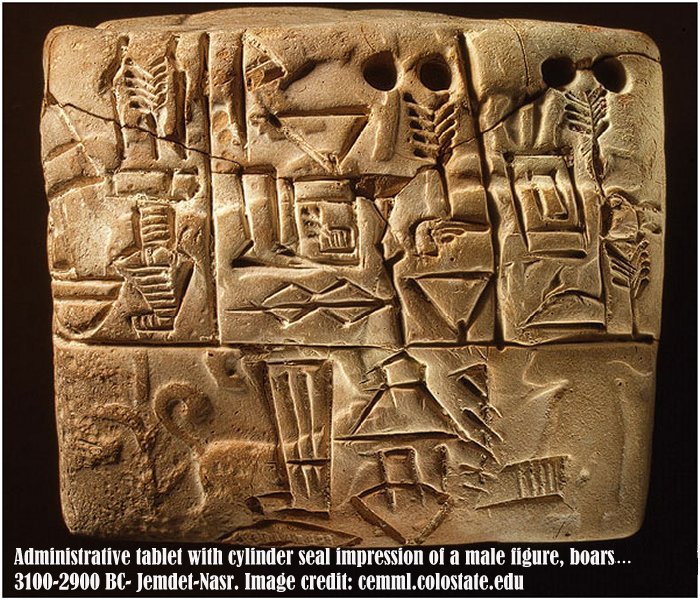
The Jemdet Nasr period represents the final stage before the Sumerian Early Dynastic Period began in southern Mesopotamia.
No evidence for far-reaching trade contacts, exotic goods or precious stones were found, but Jemdet Nasr must have had intensive regional contacts with several cities in southern Mesopotamia, including Larsa, Nippur, Ur, Uruk, and Tell Uqair. Power was concentrated in the hands of kings-priests and religion played an important role in the social life of the city. During the Jemdet Nasr period increased the number of cities, temples, and buildings.
Sophisticated irrigation techniques were used for growing plants, which was very important due to inadequate rainfall.
The production of bronze, an alloy of copper and other metals, mainly tin, allowed the production of new weapons, and fortifications around the villages and city walls were built for better protection.
Written by – A. Sutherland AncientPages.com Senior Staff Writer
Copyright © AncientPages.com All rights reserved. This material may not be published, broadcast, rewritten or redistributed in whole or part without the express written permission of AncientPages.com
Expand for referencesMore From Ancient Pages
-
 Mystery Of The ‘Mummified Mermaid’ In Japan Solved!
-
 The Burnt City And Its Mysterious Prehistoric Inhabitants
-
 Bolivia And The Mystery Of The Twins Of Atlantis
-
 Three Roman Shipwrecks Discovered Off Tunisian Coast – One Is 2,000-Year-Old
-
 Ancient Burial Chambers Decorated With Mythological Figures Of Hercules, Medusa, Eros – Unearthed In Bursa, Turkey
-
 New Treasures Found On The Legendary Shipwreck San José Near Colombia
-
 On This Day In History: Peasants’ Revolt First Great Popular Uprising In English History – On June 12, 1381
-
 Shrine Discovered In Egyptian Temple And Evidence Of Previously Unknown Rituals
-
 How Did Sargon Become The Most Powerful Ruler Of Mesopotamia?
-
 Common Ancestor Of Neanderthals And Humans That Lived 700,000 Years Ago Holds Clues To A DNA Mystery
-
 Hidden Ancient Underground Tomb Discovered In Petra May Solve The Mystery Of The Nabataean Kingdom
-
 Ancient Tombs Of The Nobles In The Valley Of The Queens
-
 Where Does The Expression “Pyrrhic Victory” Come From?
-
 Why Is The Oseberg Ship Burial A Great Viking Mystery?
-
 Traces Of Ancient Near East Civilization In America – An Out-Of-Place Ancient Inscription – Part 2
-
 Relics Dated To Byzantine And Late Period Unearthed In Meir Necropolis In Assiut, Upper Egypt
-
 More Than Drought Behind Ancient Maya Civilization’s Collapse
-
 Roman Roads Laid The Foundation For Modern-Day Prosperity – New Study Claims
-
 Battle Of Abrittus: Roman Emperor Decius And His Troops Ambushed And Defeated By Invading Goths
-
 X-Ray Of Skulls Reveals Vikings Suffered From Several Diseases

