
Pacific God A’a: Fascinating Polynesian Sculpture Designed To Carry A Human Skull And Bones
A. Sutherland - AncientPages.com - A sculpture of the Pacific God A'a is a fascinating piece of art. The figure of A'a is probably the most famous Polynesian sculpture in the world. It is designed to carry a human skull and bones.
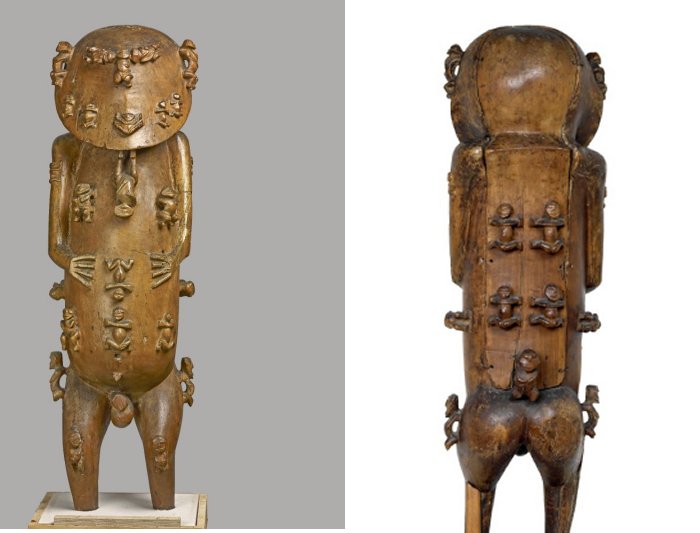
God figure (made of wood) known as A’a, carved in an anthropomorphic form with 30 small anthropomorphic figures over the surface of the body and making up the facial features. A lidded cavity in back. Image credit: The British Museum
The enigmatic sculpture of this deity has influenced poets and artists worldwide, including, first of all, people in Polynesia.
Henry Moore (1898 – 1986), an English sculptor and artist, and the famous Pablo Picasso both had their casts made of the figure; poet William Empson wrote a poem about A'a and the Museum, and it continues to inspire people today.
A'a was created to contain the divine – the figure would originally have been used to hold the skull and bones of an important ancestor.
A'a was an essential and sacred figure in Rurutu and was one of the most highly prized pieces collected by the London Missionary Society (LMS).
In 1821, islanders on the Polynesian island of Rurutu gave a group of British evangelical missionaries a figure of a deity known as A'a as a symbol of their conversion to Christianity.
Thirty unique small figures sprang from its body, representing fertility and the god's ability to create life.
Today, it is one of the most famous, intriguing, and unique objects in the British Museum.
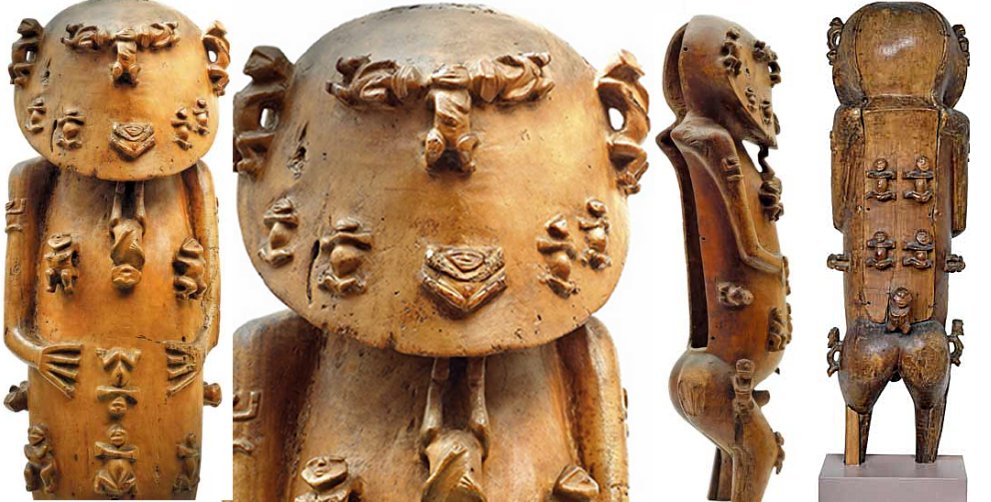 Researchers realized that A’a is made of sandalwood. Wood samples showed it was made much earlier than previously thought – possibly as early as 1505. Its cavity is designed for a human skull and long bones to fit perfectly within, wrapped in sacred materials such as the barkcloth, feathers, and human hair which were also discovered inside. Credits: British Museum
The style of Rurutu, to the north of the group, uses the star design and chevrons but is otherwise less ornate. Some objects were traded to other islands, the most common being fly-whisk handles, which were exported to Tahiti.
Each handle was topped by a pair of figures placed back to back. The shaft below was incised with chevrons or, more characteristically, consisted of a vertical series of spools. Slender spearheads were carved with miniature stylized pigs, resembling phalli.
Carved wooden shafts partly covered with woven sennit were sacred objects on Rurutu, as elsewhere in Polynesia.
Perhaps the only surviving example of figure sculpture from Rurutu is one of the most impressive Polynesian sculptures: an image of A'a creating men and other gods. The primary figure, in Society Islands style, has 30 small stylized figures arranged symmetrically on its torso, limbs, and face, 10 being placed as the facial features.
The figure has a hollow back and, when found, contained 24 small figures (now lost).
Recently, researchers realized that A'a is made of sandalwood. Wood samples showed it was made much earlier than previously thought – possibly as early as 1505.
Its cavity is designed for a human skull and long bones to fit perfectly within. It was also discovered inside, wrapped in sacred materials such as barkcloth, feathers, and human hair. One tiny red feather lodged in a splinter had gone unnoticed for 200 years.
Written by – A. Sutherland - AncientPages.com Senior Staff Writer
Updated on Apr 26, 2024
Copyright © AncientPages.com All rights reserved. This material may not be published, broadcast, rewritten or redistributed in whole or part without the express written permission of AncientPages.com
Expand for referencesReferences:
Gell A. Art and Agency: An Anthropological Theory
Grey George. Polynesian Mythology And Ancient Traditional History Of The New Zealanders
More From Ancient Pages
-
 INAH Researchers Deciphered Hieroglyphs And Identified 14 Maya Rulers In Ancient City Of Cobá, Mexico
-
 Missing Piece Of A Linguistic Puzzle: Ancient DNA Identifies The Originators Of Indo-European Languages Spoken By 40% Of The World
-
 Cernunnos ‘Horned One’ – Powerful Continental God Preserved In Celtic Beliefs As Master Of Animals
-
 4,000-Year-Old Serpent-Shaped Wooden Stick Unearthed in Southern Finland
-
 Beautiful Gold ‘Lynx’ Earrings Discovered In The Ruins Of The Ancient Lost City Of Ani Go On Display In 2023
-
 Sarcophagus Of The Amazons: Etruscan Coffin With Paintings Of Dynamic Fighting Scenes Of Greeks With Amazons
-
 Ancient DNA Reveals How European Skin, Eye, And Hair Color Evolved Over The Past 45,000 Years
-
 The “Drunk Hypothesis” And Alcohol’s Crucial Role In Numerous Early Civilizations
-
 Mystery Of The Sphinx – A Guardian Of Knowledge And Symbol Of Riddles And Intrigue
-
 Mysterious Inca Citadel With Platforms, Passages And Walls Discovered In Peru’s Rainforest
-
 Ancient Egypt Life and Death in the Valley of the Kings Death
-
 Could Vancouver Island’s Hepburn Stone Be 15,000 Years Old?
-
 Unusual Tiny Ancient Dwellings Captivate Archaeologists – Village Of Ancient Dwarves Or Something Else?
-
 Well-Preserved 7,300-Year-Old Wooden Cabins Discovered In La Draga
-
 The Rise And Fall Of The Sasanian Empire
-
 Curious Giant Shaped Rock In China – An Ancient Man-Made Construction Or Natural Formation?
-
 Impressive Gaulcross Hoard Reveals Secrets Of Mysterious Picts
-
 Disgusting Vandalism And Looting Of Viking Graves In Norway
-
 Pictograms: First Written Accounts Of Earthquakes In Pre-Hispanic Mexico
-
 Unusual Secret Found In Tycho Brahe’s Alchemy Laboratory

