
Stunning Underwater Photos Reveal Secrets Of Legendary Lost City Of Heracleion
Ellen Lloyd - AncientPages.com - In ancient times, the city of Thonis-Heracleion, known in modern tiles as the lost kingdom of Cleopatra served as a gateway to Egypt. Today, this mysterious legendary city is submerged in Egypt's Aboukir Bay, near Alexandria.
Why the city sank remains a mystery, but it was swallowed by the Mediterranean Sea and has been buried in sand and mud for more than 1,200 years.
New amazing underwater discoveries allow archaeologists to piece together clues and to create an image of what life was like in the ancient city.
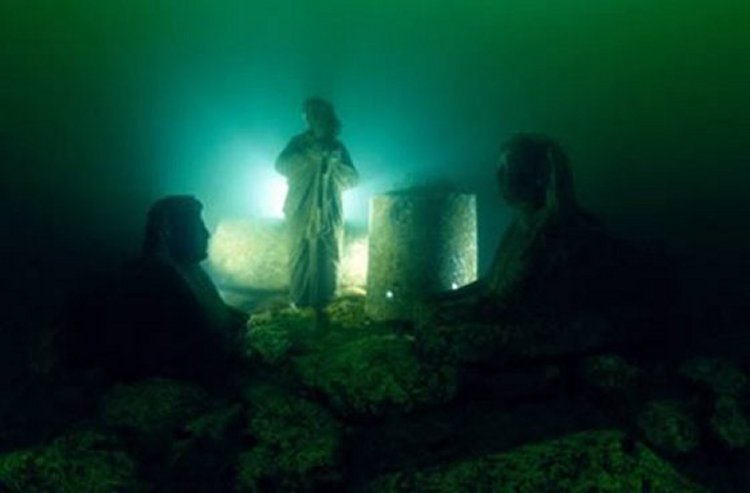
Mysterious ancient figures buried beneath the water. © Franck Goddio/Hilti Foundation, photo: Christoph Gerigk
Known as Heracleion to the ancient Greeks and Thonis to the ancient Egyptians the city was rediscovered in 2000 by French underwater archaeologist Dr. Franck Goddio and a team from the European Institute for Underwater Archaeology (IEASM) after a four-year geophysical survey.
"Prior to its discovery in 2000 by the IEASM, no trace of Thonis-Heracleion had been found.
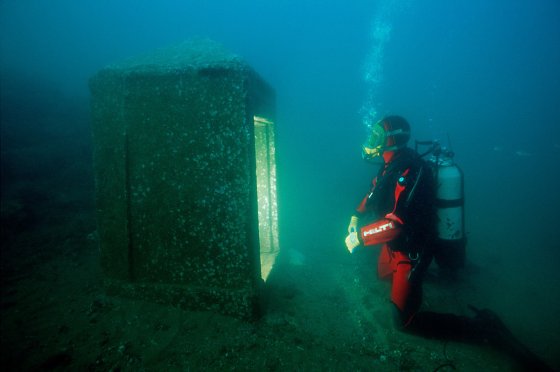
Among the most important monuments that were discovered at the temple area of Thonis-Heracleion is this monolithic chapel (naos) dating to the Ptolemaic period. It served as a key for the identification of the city. © Franck Goddio/Hilti Foundation, photo: Christoph Gerigk
Its name was almost razed from the memory of mankind, only preserved in ancient classic texts and rare inscriptions found on land by archaeologists.
The Greek historian Herodotus (5th century BC) tells us of a great temple that was built where the famous hero Herakles first set foot in Egypt.
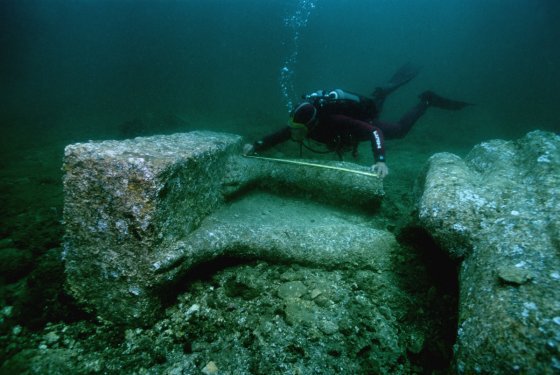
An archaeologist measures the feet of a colossal red granite statue at the site of Heracleion discovered in Aboukir Bay. © Franck Goddio/Hilti Foundation, photo: Christoph Gerigk
He also reports of Helen's visit to Heracleion with her lover Paris before the Trojan War. More than four centuries after Herodotus' visit to Egypt, the geographer Strabo observed that the city of Heracleion, which possessed the temple of Herakles, is located straight to the east of Canopus at the mouth of the Canopic branch of the River Nile," Dr. Frank Goddio writes on his website.
As we have previously seen in our article Lost Kingdom Of Cleopatra - An Amazing Egyptian Underwater City scientists believe that the entire city was completely submerged, along with all the artifacts, statues, columns, and other beauties of the palace of Cleopatra.
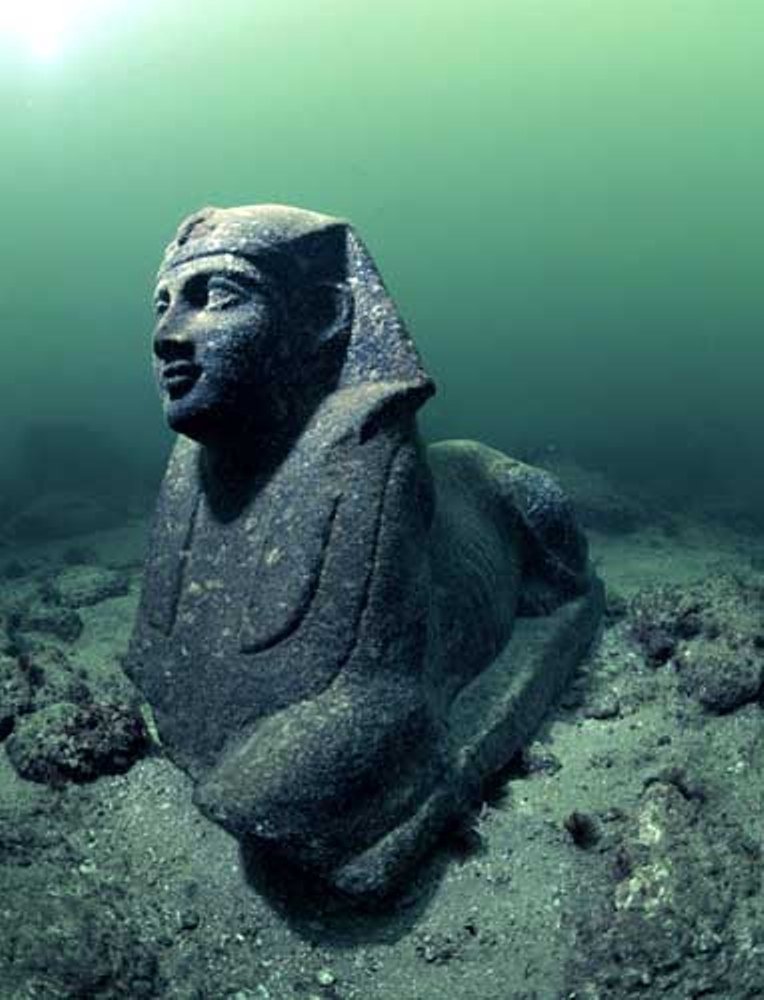
Today, these ancient statues are like forgotten memories of the past. © Franck Goddio/Hilti Foundation, photo: Christoph Gerigk
Several of the submerged artifacts remained largely intact. Amongst the discoveries were the palace's foundations, shipwrecks, red granite columns, and statues of the goddess Isis and a sphinx.
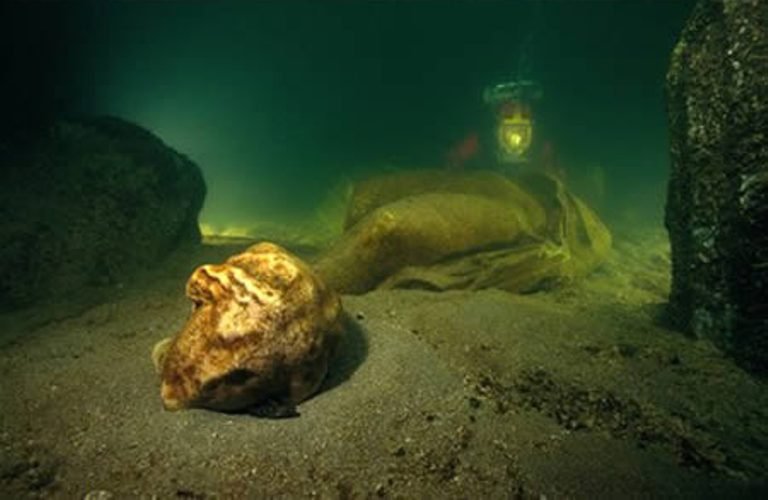
Once this was part of Cleopatra's kingdom. © Franck Goddio/Hilti Foundation, photo: Christoph Gerigk
Among the massive limestone blocks toppled in the fourth century was a huge quartzite block engraving a pharaoh. An inscription indicates it depicts Seti I, father of Ramses II.
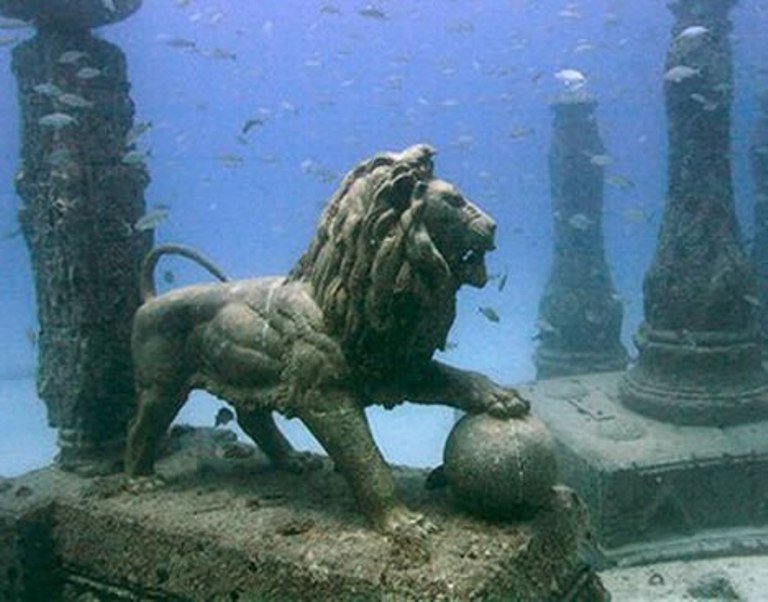
A lion statue standing underwater.
Divers also discovered a colossal stone head believed to be of Caesarion, son of Cleopatra and previous lover Julius Caesar, and two sphinxes, one of them probably representing Cleopatra's father, Ptolemy XII.
Researchers believe that the city was a central area used as a customs hub where trade coming from Greece and other places in the Mediterranean entered Egypt.
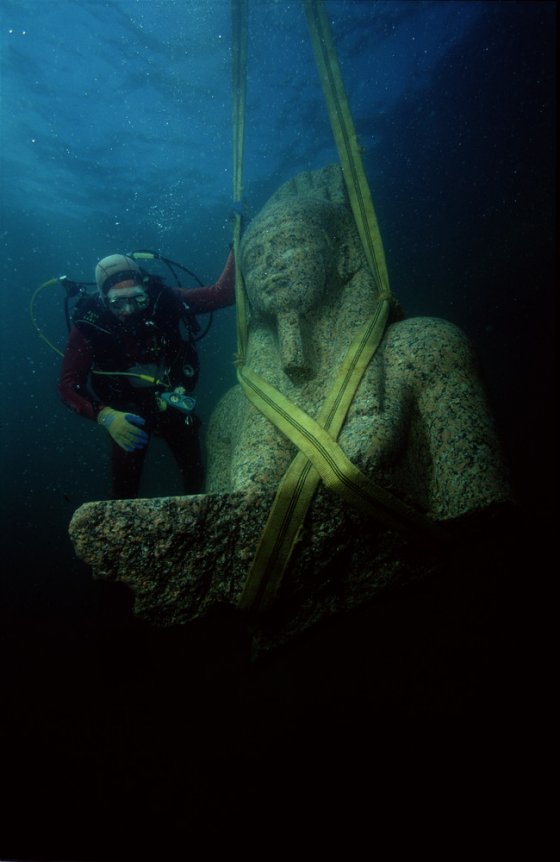
A colossal statue of red granite (5.4 m) representing the god Hapi, which decorated the temple of Heracleion. The god of the flooding of the Nile, symbol of abundance and fertility, has never before been discovered at such a large scale, which points to his importance for the Canopic region. © Franck Goddio/Hilti Foundation, photo: Christoph Gerigk
"The site has amazing preservation. We are now starting to look at some of the more interesting areas within it to try to understand life there," said Dr. Damian Robinson, who is working on the site and is director of the Oxford Center for Maritime Archaeology at the University of Oxford.
"We are getting a rich picture of things like the trade that was going on there and the nature of the maritime economy in the late Egyptian period. There were things that were coming in from Greece and the Phoenicians."
"It is a major city we are excavating," Robinson said.
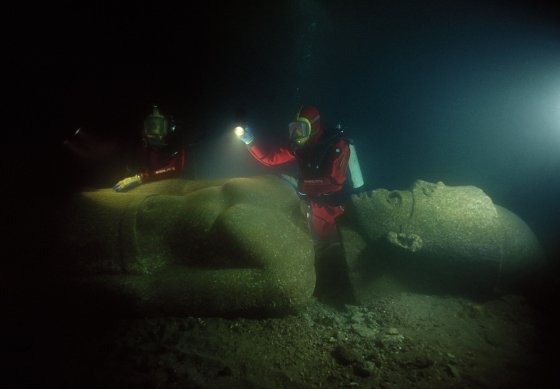
Franck Goddio and divers of his team are inspecting the statue of a pharaoh. The colossal statue is of red granite and measures over 5 metres. It was found close to the big temple of sunken Thonis-Heracleion and reassembled on the site. © Franck Goddio/Hilti Foundation, photo: Christoph Gerigk
Everyone who finds underwater archaeology a fascinating subject can now look forward to Dr. Giddo's new documentary that will highlight the major discoveries that have been unearthed at Thonis-Heracleion during a 13-year excavation.
"By lying untouched and protected by sand on the seafloor for centuries, they are brilliantly preserved." Among the finds is the largest known statue of the Egyptian god of the Nile flood (Hapi) and one of the largest known concentrations of ancient ships. Additionally, there are well-preserved shrines from the heart of the temple area, votive items and jewelry, coins, and finely carved official inscriptions on stone documenting life in the city and exchange with other cultures.
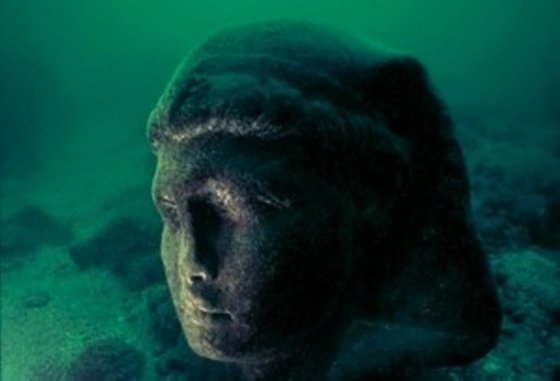
A sunken statue discovered underwater outside of Egypt. © Franck Goddio/Hilti Foundation, photo: Christoph Gerigk
"The archaeological evidence is simply overwhelming," said Professor Sir Barry Cunliffe, a University of Oxford archaeologist taking part in the excavation. "By lying untouched and protected by sand on the seafloor for centuries they are brilliantly preserved."
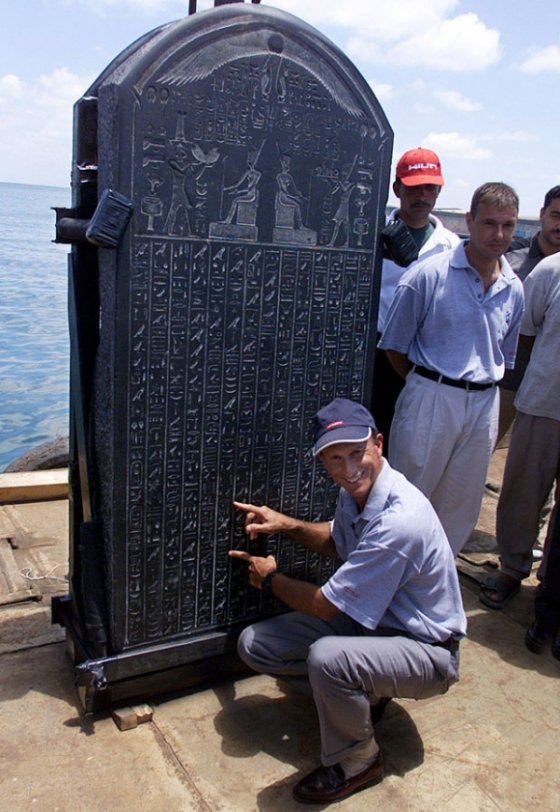
French Marine archaeologist Frank Goddio explains text on the stele of Heracleion on a barge in an Alexandria naval base June 7, 2001.
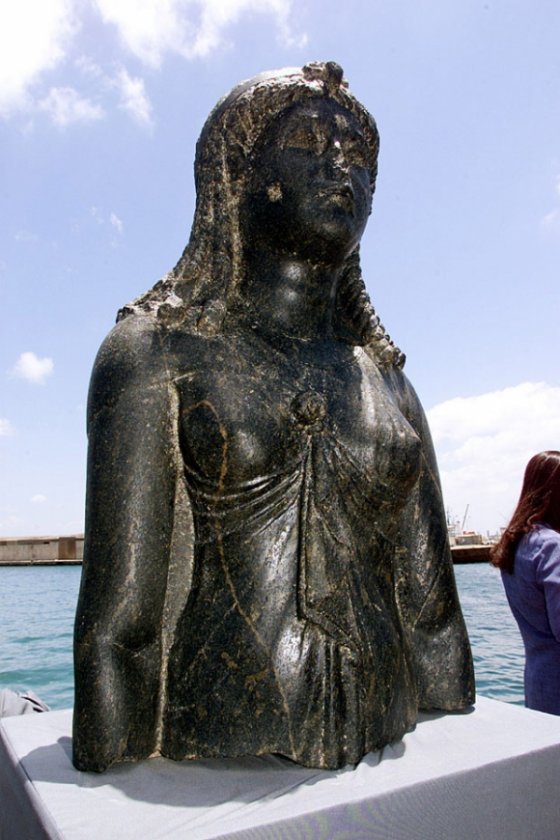
The statue of the Goddess Isis sits on display on a barge in an Alexandria naval base on June 7, 2001.
Many advanced ancient civilizations ended due to earthquakes, tsunamis, or other natural disasters, and we are now looking at their artifacts.
There are many ancient secrets at the bottom of the oceans. We can learn more about our ancestors with the help of emerging technologies that allow us to explore the depths as never before.
Written by - Ellen Lloyd – AncientPages.com
Copyright © AncientPages.com All rights reserved. This material may not be published, broadcast, rewritten or redistributed in whole or part without the express written permission of AncientPages.com
More From Ancient Pages
-
 Lacrosse Was Invented By Native American Indians
-
 Evidence Of Biblical Kingdom Of Edom In Arava Desert – Discovered
-
 Artifacts And Long History Of Unguja Island – Ancient Humans Impact Island’s Environment
-
 Baffling North American Ancient Skulls Contradict Historical Timelines And Mainstream Theories
-
 Mythical Temple Of Wingded Warrior God Haldi In The ‘City Of The Raven’
-
 10th Century Sculpture Of Sun God Surya Accidentally Found In Farmland In Andhra Pradesh
-
 Rock-Cut Tombs Of Beni Hasan With Spells, Prayers To Osiris And Anubis And Map To Underworld
-
 Don’t Underestimate The Rishis – Ancient Sages Were ‘Probably Great Scientists’
-
 Recreation Of Cleopatra’s Ancient Perfume
-
 Armenia: Old Land Where Myths, Legends And Long History Meet
-
 5,000-Year-Old Bryn Celli Ddu Funeral Complex Reveals More Secrets
-
 Mysterious Medes: Was It An Ancient City Of Ecbatana?
-
 Isaac Newton Believed Egyptian Pyramids Held Key To The Apocalypse – Unpublished Manuscripts Reveal
-
 Who Was The Unknown Man Who Influenced Historical Events Shaping America’s Future Before Vanishing Forever?
-
 8,000-Year-Old Yarmukian ‘Mother Goddess’ Figurine Discovered In Israel
-
 Secrets Of Ancient Underwater City Pavlopetri Revealed – Travel Back In Time And See What The City Looked Like!
-
 On This Day In History: Alexander The Great Died In Babylon – On June 11, 323 BC
-
 Subterranean Kingdom Of Shahmaran And The Land Of The Snakes
-
 Magnificent ‘Sword Pyramid’ Lost By A Sutton Hoo-Era Lord Discovered In Norfolk
-
 Amulets, Figurines Discovered In Recently Unearthed Limestone Sarcophagus In Minya, Egypt

