
Napoleonic Code: Why Was One Of The Most Influential Civil Codes Flawed?
A. Sutherland - AncientPages.com - Napoleonic Code was the French Civil Code introduced under Napoleon I on 21 March 1804.
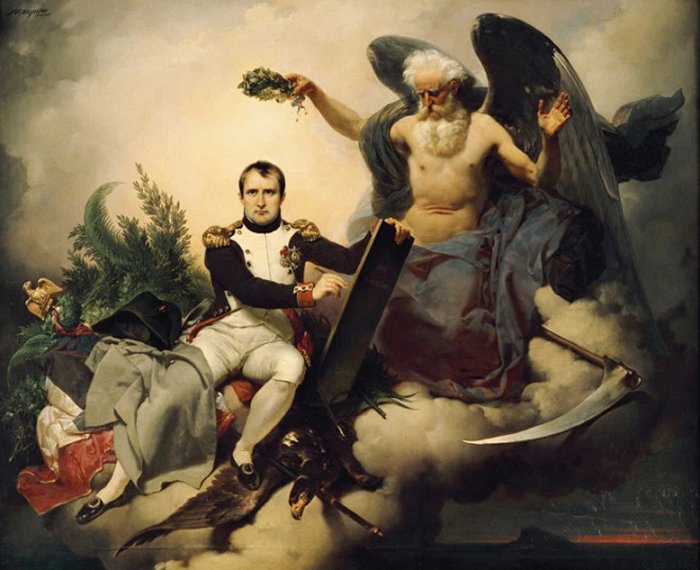
“Napoleon I, crowned by the Allegory of Time, writes the Code Civil” Jean-Baptiste Mauzaisse, 1833.
It was the first consistent set of laws concerning criminal and commercial law, property, the family, colonial affairs, and individual rights, given by Napoleon to his people living in post-revolutionary France. The Code eliminated feudalism, supported religious tolerance, and introduced other liberal European reforms.
It is a set of organized laws, considered one of Napoleon's most essential and lasting legacies. The French military commander and political leader Napoleon Bonaparte (1769–1821) was inspired by Roman law and principles of the French Revolution to create this progressive legal system,
It has been generally considered a progressive legal system reflecting broad-minded values. The Code required that for laws to be applied appropriately, secret laws were ended. Ex post facto laws were invalidated, and procedures were needed to make the application of the rules fair.
Unfortunately, colonial slavery was reintroduced. The Code was modified and widely adopted outside France in Europe and the Western Hemisphere.
However, the Napoleonic Code made the authority of men over their families stronger, deprived women of any individual rights, and reduced the rights of illegitimate children.
The Code may not have been favorable for women, historians say.
Napoleonic Code And Women
The Code made women legally and economically dependent on men. Women acquired their husbands' nationality upon marriage and had to reside where their husbands desired. The Code guaranteed the supremacy of the man over his wife and children; the husband was the ruler of the household.
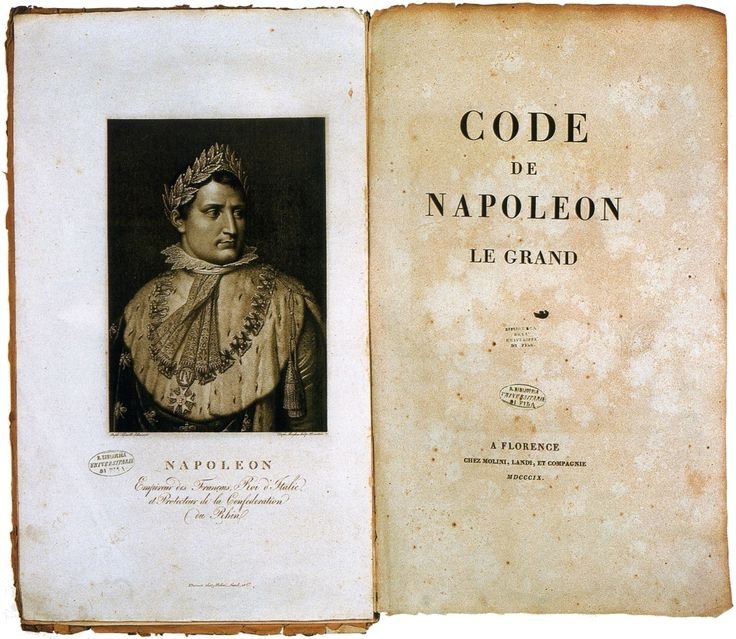
Code de Napoleon Le Grand/ The Napoleonic Code. Source
In "Changing Lives: Women in European History Since 1700", Bonnie G. Smith writes:
"Women could not participate in lawsuits or serve as witnesses in court or as witnesses to civil acts such as births, deaths, and marriages. Such a reduction in a woman's civil status enhanced that of the individual male.
Moreover, the Code reduced, if not eliminated, male accountability for sexual acts and thrust it squarely on women. For example, men were no longer susceptible to paternity suits or legally responsible for the support of illegitimate children.
Economically, women were weakened if they bore illegitimate children. Men, on the other hand, were not so affected if they fathered them. Finally, female adultery was punished by imprisonment and fines unless the husband relented and took his wife back.
Men, however, suffered no such sanctions unless they brought their sexual partners into the home. The sexual behavior of women was open to scrutiny and prescribed by law, whereas that of men, almost without exception, had no criminal aspect attached to it.
Thus, "male sexuality was accepted with few limitations, but women's was only acceptable if it remained within strict domestic boundaries." (Bonnie G. Smith, Changing Lives: Women in European History Since 1700)
The abolition of divorce by mutual consent amounted to a significant regression for French women.
- A woman cannot contract a new marriage until ten months have elapsed from the dissolution of the preceding marriage.
- The wife may demand a divorce on the ground of adultery in her husband when he shall have brought his concubine into their shared residence.
- The married parties may reciprocally demand divorce for outrageous conduct, ill-usage, or grievous injuries, exercised by one of them towards the other. 1
As the Napoleonic Code strongly influenced many legal systems in Europe and the New World, it also set the terms for treating women widely. Napoleon was pleased that his new laws had been spread throughout the empire, and said late in his life:
'Waterloo will wipe out the memory of my forty victories, but that which nothing can wipe out is my Civil Code. That will live forever.'
An original copy of the Napoleonic Code is stored in the Historisches Museum der Pfalz in Speyer, Germany.
Written by – A. Sutherland - AncientPages.com Senior Staff Writer
Updated on January 1, 2024
Copyright © AncientPages.com All rights reserved. This material may not be published, broadcast, rewritten or redistributed in whole or part without the express written permission of AncientPages.com
Expand for referencesReferences:
Smith B. G. The Oxford Encyclopedia of Women in World History
- Philip G. Dwyer, Napoleon and Europe
More From Ancient Pages
-
 3,600-Year-Old Bronze Dagger Made By The Minoan Civilization Found On Ancient Shipwreck
-
 Mystery Of The Ancient Foggaras: Sahara’s Incredible Masterwork Of Antiquity
-
 How Did Hindu God Shiva Get His Third Eye?
-
 7,000-Year-Old Unique Artifacts Discovered Under Melting Ice In Canada
-
 How Did The Early Rapa Nui People Put Huge Hats On Giant Statues Of Easter Island?
-
 Ancient Irish Were First To Record An Eclipse – 5,355 Years Ago
-
 Native American Population Does Not Originate In Japan – Genetics And Skeletal Biology Questioned
-
 Why Was The Iron Age Village Near Elgin In Scotland Suddenly Abandoned And Burned Down?
-
 On This Day In History: William Penn – English Philosopher, Quaker And Founder Of Pennsylvania Was Born – Oct 14, 1644
-
 Astronomer Johannes Kepler Saved His Mother From Being Burned As A Witch
-
 Artificial Intelligence Reveals The Out Of Africa Expansion Is More Complex Than Previously Thought
-
 Ah Puch: Evil Death God Of Underworld Who Hated Souls In Maya Beliefs
-
 Long-Lost Paleontological Site With More Than 100 Unique Fossils Re-Discovered In Brazil
-
 Three Ancient Tombs Of High-Ranking Officials Discovered In Luxor, Egypt
-
 Ancient Mesopotamian Artifacts Unearthed In Kurd Qaburstan Fill A Historical Gap
-
 Historic Shipwreck Margaret A. Muir Found In Lake Michigan, Wisconsin
-
 Viking Age Shields From The Gokstad Ship Burial – Re-Examined
-
 Large Ancient Roman Necropolis Is Buried Beneath The Gaza Strip – Can It And Other Ancient Treasures Be Saved?
-
 Beavers Had A Big Influence On How Stone Age People Lived
-
 Celtic Knot Decorated Bible, Gospels, Celtic Crosses And Symbolized Strength, Love And Continuity Of Life

