
What Ancient Civilization Discovered Metallurgy?
AncientPages.com - The science behind metallurgy goes far back in time, but it's uncertain when and where humans invented metal smelting.
Researchers now think they have found the answer to this long-debated question in the history of technology. Apparently, metallurgy does not have a single origin, but probably arose at various locations at about the same time.
The experts reached this conclusion after re-examining the 8,500-year-old copper slag and analyzing the chemical composition of other copper artifacts from the Stone Age settlement of Çatalhöyük in the Near East.
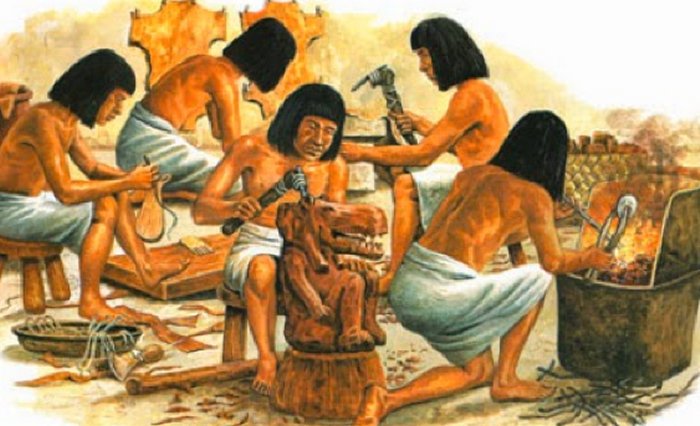
Scientists have debated for a long time who discovered metallurgy.
There is evidence copper metal was already being processed at the beginning of the Neolithic Age approximately 10,000 years ago in the Fertile Crescent from the Levant through East Anatolia to the Zagros Mountains in Iran.
"But because this is all pure, native copper, we can't really call it true metallurgy," explains Prof. Dr Ernst Pernicka, Scientific Director of Heidelberg University's Curt Engelhorn Centre for Archaeometry, which is located in Mannheim.
Copper is found in nature as metal, and according to the researchers, was probably considered a special type of stone. But because the production of metal from ore ushers in a new era in human history, it is important to know when and where it first developed and whether metal smelting really originated in a single location.
See also:
Aluminum Was Used At Least 7,000 Years Ago – Long Before The Metal’s Official Invention In 1825
Telangana And Great Ancient Iron Masterwork Of Skilled Blacksmiths Of India
It was long believed that a small amount of copper slag from the Neolithic site at Çatalhöyük was thought to be the earliest evidence for pyrometallurgical extraction of copper from ore.
This settlement existed from approximately 7,100 to 6,000 BC and is considered to be the most significant site in the Near East that affords any insight into the development of human habitats. The copper slag was located in layers that dated back to 6,500 years before Christ and was therefore 1,500 years older than the world's earliest evidence of copper smelting.

Copper bead from Çatalhöyük. It consists of very pure copper in metal form, as found in nature. Image credit: Picture: M. Radivojevic, CC BY-NC-SA 3.0
"The find seemed to point to the birthplace of metallurgy, with the technology slowly spreading from there in all directions," states Prof. Pernicka, who also heads the Archaeometry and Archaeometallurgy Research Group at the Institute of Earth Sciences at Heidelberg University.
However new studies, including those at the Curt Engelhorn Centre for Archaeometry, have demonstrated that the slag was an unintentional by-product of a domestic fire. The extreme heat of the fire slagged the green copper ores, which were used as pigment. The slag differs in chemical composition from another artefact from the Stone Age settlement, a bead of folded sheets made of pure copper.
This threw new light on the scientific significance of the copper slag of Çatalhöyük, now putting the earliest known examples of copper extraction from ore around 5,000 BC in Southeast Europe and Iran.
The current findings indicate that this revolutionary development in humankind probably came about at roughly the same time but in multiple locations. "We thereby solved a controversial problem in the history of technology," underscores Professor Pernicka.
AncientPages.com
Expand for referencesMore From Ancient Pages
-
 Ancient Stone Cylinders Shed New Light On The Invention Of Writing In Mesopotamia
-
 Bread Sack Of Saint Francesco Of Assisi: 700 Years Old Myth Confirms Authenticity Of A Relic
-
 Stone Water Well Dated To Sassanid Era (224-651 CE) Unearthed In Isfahan Hills, Iran
-
 New Inscriptions, Gold And Paint Showed Thanks To Restoration In Temple Of Edfu
-
 Death And Afterlife In Ancient Egyptian Beliefs – Death As Transition To Another Reality
-
 Roman-Germanic Mythical Kneeling Figure With A Human Head And Snake’s Body Unearthed At Stuttgart’s Excavation Site
-
 Neith – Fearsome Egyptian Mother Of The Gods – Creator Of Sun God Ra, His Archenemy Serpent God Apophis And The Universe
-
 Mysterious And Feared Underground World That No One Can Visit And Return To Tell About – Cherokee Reveal A Secret
-
 Ukraine – A Place Where People From Different Cultures Intersected Until About 500 Years Ago
-
 Who Was The Woman Buried With 25 Warrior Monks Of The Order Of Calatrava At The Castle At Zorita De Los Canes, Guadalajara?
-
 Gods’ Creation Of Five Different Human Races – Ages Of Man On The Earth And The End Of The World
-
 World’s Oldest Tattoo Tools Discovered In Tennessee, North America
-
 Vast Network Of Previously Unknown European Bronze Age Megastructures Discovered
-
 First Near-Complete Sauropod Dinosaur Skull Found In Australia Hints At Ancient Links Between Continents
-
 Unique Geoglyphs In Torgay, Kazakhstan – Destroyed
-
 Philippine Archipelago: Home To An Advanced Maritime Culture Approximately 35,000 Years Ago
-
 Archaeological Evidence Amazon Warrior Women Did Exist Found At Nakhchivan Necropolis, Azerbaijan
-
 The Thunder Stone: World’s Largest Monolith Moved By Man
-
 There Is Evidence Humans Reached North America 130,000 Years Ago – Archaeologist Says
-
 ‘Exceptional’ Ancient Roman Bath Complex Discovered In Mérida, Spain

